Icon - Arrow LeftAn icon we use to indicate a rightwards action. Icon - Arrow RightAn icon we use to indicate a leftwards action. Icon - External LinkAn icon we use to indicate a button link is external. Icon - MessageThe icon we use to represent an email action. Icon - Down ChevronUsed to indicate a dropdown. Icon - CloseUsed to indicate a close action. Icon - Dropdown ArrowUsed to indicate a dropdown. Icon - Location PinUsed to showcase a location on a map. Icon - Zoom OutUsed to indicate a zoom out action on a map. Icon - Zoom InUsed to indicate a zoom in action on a map. Icon - SearchUsed to indicate a search action. Icon - EmailUsed to indicate an emai action. Icon - FacebookFacebooks brand mark for use in social sharing icons. flipboard Icon - InstagramInstagrams brand mark for use in social sharing icons. Icon - PinterestPinterests brand mark for use in social sharing icons. Icon - TwitterTwitters brand mark for use in social sharing icons. Icon - Check MarkA check mark for checkbox buttons.
You are reading

The Beauty of Imperfection: A Favorite Garden at this Year’s Chelsea Flower Show

Search

The Beauty of Imperfection: A Favorite Garden at this Year’s Chelsea Flower Show

May 19, 2026

There’s a lot to be distracted by at the Chelsea Flower Show. From driftwood gorillas to the unveiling of this year’s rose from David Austin, it can be difficult to fully digest all the show gardens and the stories that the designer and sponsor are trying to tell. But a creative use of hard materials is always a draw and when we stopped at the Children’s Society Garden on Chelsea’s Main Avenue yesterday morning, it was a clear case of the medium being the message. And an urbane planting palette doesn’t harm communications either.

Let’s explore this gold-medal winning show garden by Patrick Clarke.

Photography by Jim Powell for Gardenista.
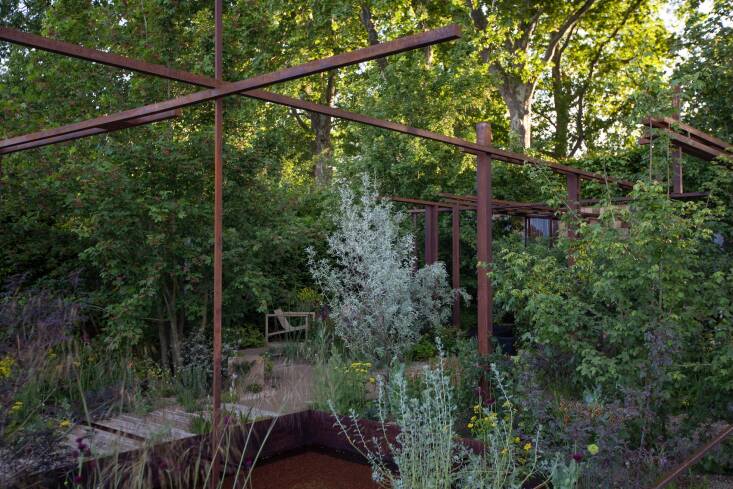
Above: The Children’s Society Garden at the Chelsea Flower Show, 2026, designed by Patrick Clarke and co-sponsored by Project Giving Back.

A garden for The Children’s Society takes a refreshingly grown-up approach to the kind of outdoor space that is intended for nurturing young people; there isn’t a primary color or slogan in sight. Instead, the focus is on providing a sense of calm sanctuary, where people can talk. The garden will be re-homed after the show to a youth club in Leighton Buzzard, as the charity’s first dedicated outdoor space; it will be used for group activities and one-to-one sessions. Guided by the contribution of “young creatives” who were involved in the making of the garden, it will benefit various youth groups.
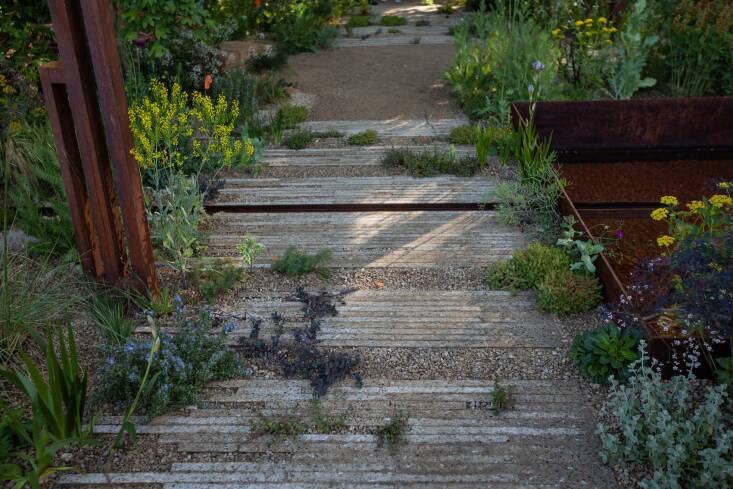
Above: The paving, gravel, rusted steel structure, rills and pond are made from reclaimed materials that succeed in adding cohesion to the planting.

“Beauty in imperfection” is the guiding principle behind landscape architect Patrick Clarke’s design. His use of materials is exquisite, and there is a warmth to the textures that rewards a closer look. Everything is rescued, reused, and recycled, starting with the rusted steel “canopy,” a post-modern pergola that is not overloaded with plants and doesn’t provide shade but it does provide a 3-dimensional framework, pulling the other materials together. It is made from old steel rafters.
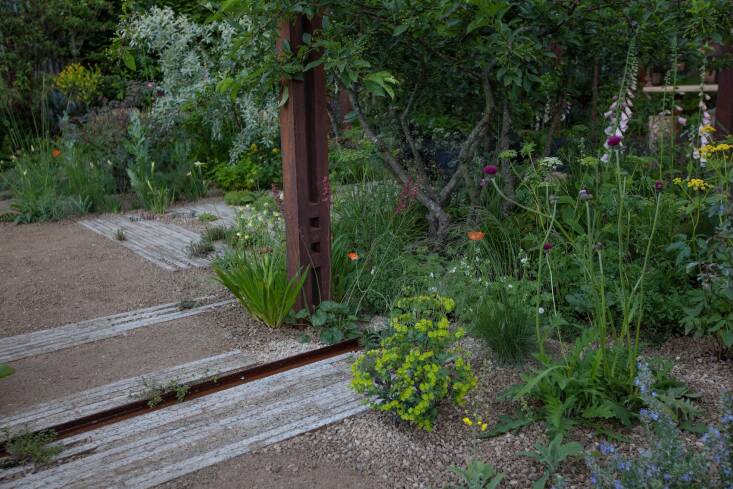
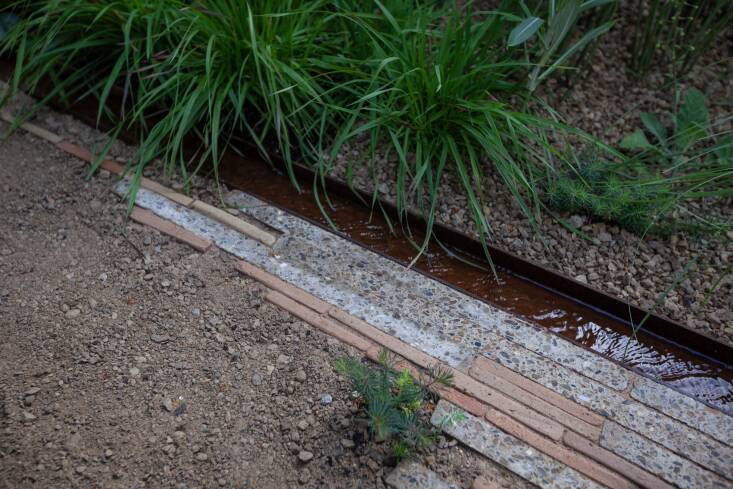
Above: Mixed materials underfoot include sliced pavers, diverted from landfill and set into recycled gravel, and a modular rill. Like the steel structure, it encloses the space; the sound and movement of water help to delineate the nurturing garden.
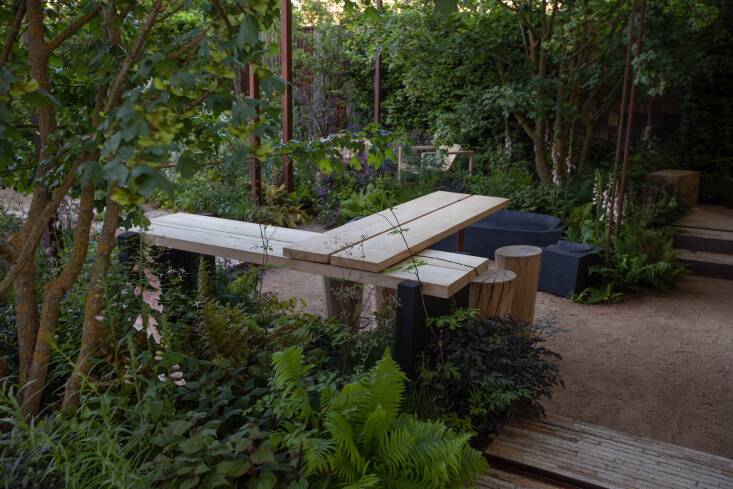
Above: A table set at bar height, with built-in stools, is the kind of structure to which anyone would gravitate, teenage or not. Made from a fallen tree on the Boconnoc Estate in Cornwall, Patrick Clarke worked with Olly Hill of Mena Woodwork + Design, who operates out of a scenic workshop in Boconnoc’s woodland, making use of windfalls amd the estate’s traditional sawmill, which has always been water-powered.
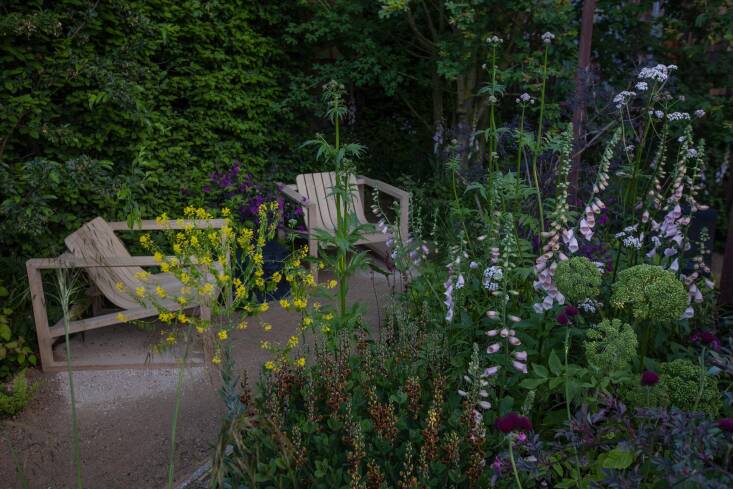
Above: Olly Hill’s signature Huer chairs, designed for outdoors, sit comfortably in this garden and add to the light-handed approach to relaxation, with no overbearing directives. Except maybe the warning that once you sit in one you might not want to get up again.
Above: Every piece of hard material works towards the ethos of this garden, the beauty of imperfection as well as hope. Intermittent paving is result of salvaging with imagination. A member of the build team says, “These were council paving slabs that were on their way to the landfill. Patrick got them out of the skip.” The slabs were cut into strips, and the insides of the pavers faced upwards to give a terrazzo effect with the aggregate chips. They were enhanced for the show “very lightly” with olive oil.
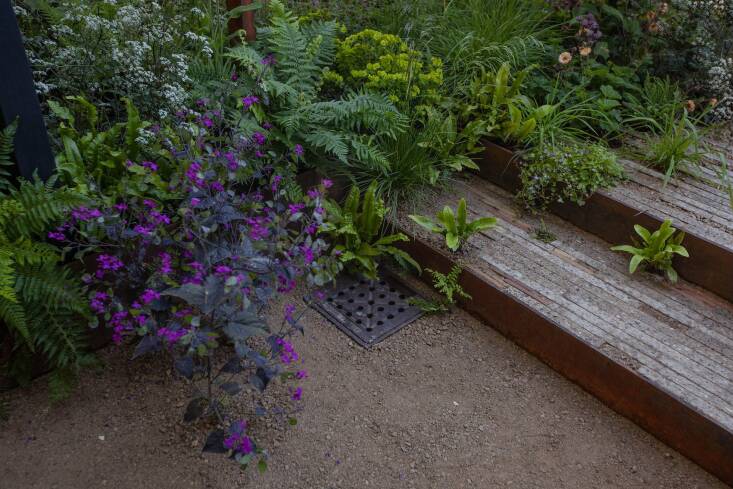
Above: The paver-strips work brilliantly for steps, and the drain—well, it’s just a nice drain (and it has a plant growing inside).
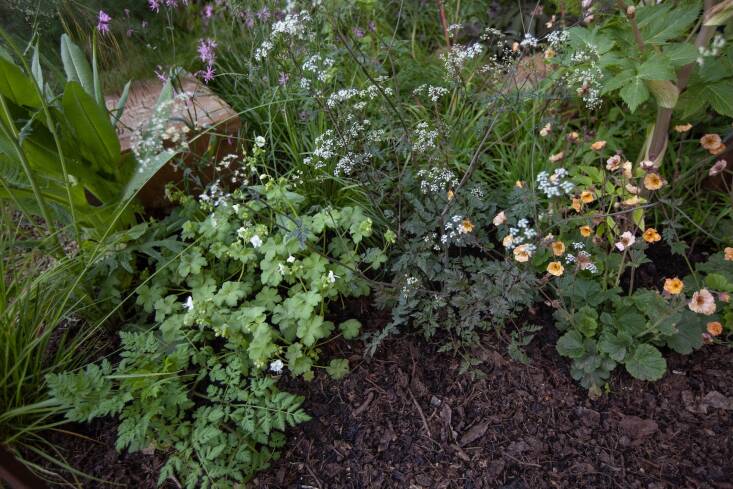
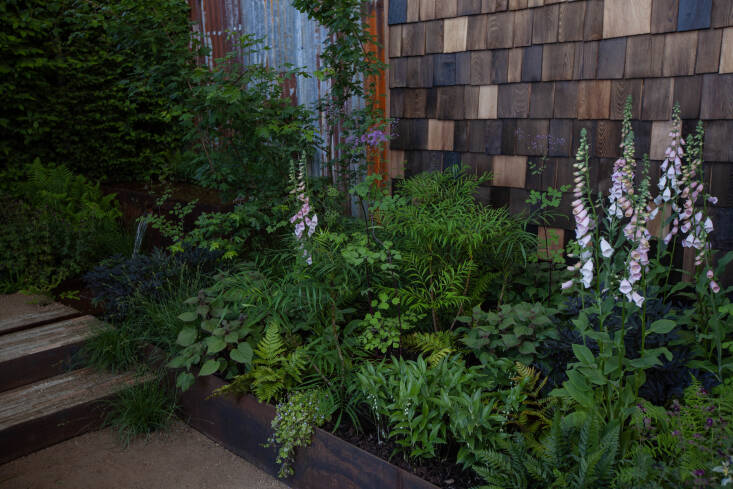
Above: Plumped up soil is an unusual sight at Chelsea these days, and in a more shaded area it is frankly a relief at the show. Boosted with leaf litter, it is home to fairly traditional garden plants growing on two sides of the garden, including geranium, geum, angelica and the glamorous, dark-stemmed cow parsley, Anthriscus ‘Ravenswing’.
Above: The “mosaic wall” around parts of the garden is testament to Patrick’s penchant for skip diving. The shingles have a comforting, familiar feeling from a distance that is difficult to pin down, but closer inspection reveals that they are mismatched and slightly different sizes, and make good companions to the sheets of corrugated metal, in their varying tones and state of wear and tear (also dragged out of a skip).
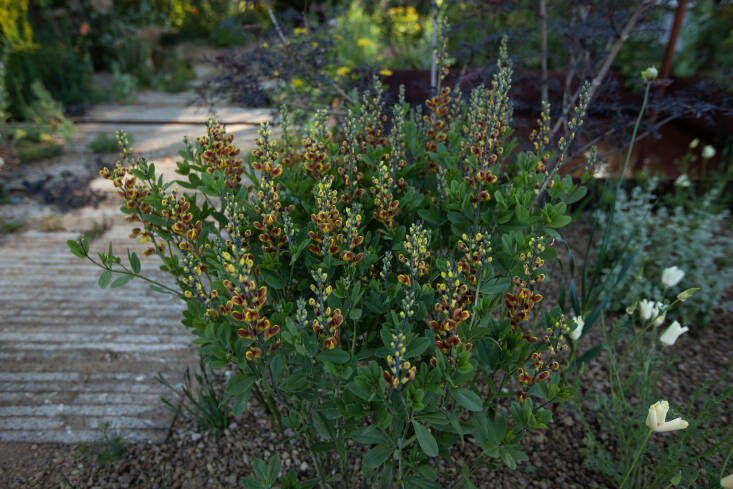
Above: Baptisia ‘Cherry’s Jubilee’ has a recurring role in this garden and with Iris ‘Holden Clough’ it shares the color spectrum with golden alexander, an upscale evening primrose, and creamy California poppy. Mingling with rust-and-yellow grasses and glaucous foliage, the discipline and elegance of the plant palette is striking. Not teenage—just universally lovely.

For our coverage of last year’s Chelsea Flower Show, see:

(Visited 1 times, 1 visits today)
You need to login or register to view and manage your bookmarks.

Have a Question or Comment About This Post?

Join the conversation

v5.0