

A fascinating new garden in the midst of London’s most pampered park (created by royal tastemaker, the Prince Regent, in the 1810s) has been dedicated to his descendent, Queen Elizabeth II. Built on a 2-acre site of disused glasshouses in the Regent’s Park, the mainly xeric planting plan was designed by Noel Kingsbury to thrive in a substrate of ground concrete mixed with intractable London clay. It looks unusual, and within the range of eight parks across London known as the Royal Parks, it is unique. The opening coincided with what would have been Queen Elizabeth II’s 100th birthday, and some of her favorite plants have been included in the scheme, including magnolia and lily-of-the-valley. But there is little resemblance to, say, the formal gardens around Buckingham Palace or even Avenue Gardens in the Regent’s Park, extravaganzas of bedding in the grand tradition. This garden symbolizes something else about the UK’s longest-reigning queen.
We went along to find out what that might be.
Photography by Clive Nichols, except where noted.

The Queen Elizabeth II Garden is about longevity and resilience. Traced with meandering paths, intersected by a wide and straight “cut-through,” the hardscaping is beautiful and the planting is complex. It is a collaboration between the Royals Parks (and its head of horticulture, wunderkind Matt Pottage), the ecological plant designer Noel Kingsbury and HTA Design. It is a park garden that has been created from a post-industrial site and the result is not the kind of landscape that the Queen would have recognized in a British park. However, she no doubt would have appreciated that it is forward-looking, promising a huge net gain in biodiversity, while it is at the same time backward-glancing, in toasting her legacy.

It is no secret that the late queen was more passionate about dogs and horses than gardens, but her love of the countryside and nature was clearly on show. The only true gardening queens have been those who married into the royal family; the German ladies who created gardens around Kew Palace (later Kew Gardens), and the Queen Mother, who passed on the torch to her grandson, Charles.

Matt Pottage, who is the Royal Parks’ very first Head of Horticulture (a role created only a couple of years ago), jumped straight into this project, which had already been approved in principle by the queen during her Platinum Jubilee year. “This isn’t maybe what you’d expect in a public park, maybe not the style of gardening you were brought up or trained to do,” he explained, when the park opened to the press. “I think most of us were trained to get rid of rubbish and undesirable materials, bring in good clean top soil, and then feed and water everything so it reaches enormous proportions. We’ve gone against that here; we’ve kept all the demolition material in the garden, and on the back of that, we’ve created quite an unusual growing environment.”

The garden is a grand vision, comprising a shady, semi-wooded arrival area with a modular metal pergola made from glasshouse structural elements; a large pond and smaller swales; viewing platforms and well-designed seating; and a mosaic of habitats, including deadwood and ivy in a woodland belt along one edge, home to the last known colony of breeding hedgehogs in a London park. “This garden will become a biodiversity hotspot with its water and meadows,” says Matt. “From the derelict place it was previously, the massive increase in biodiversity gain is something we’re passionate about: that gardens and horticulture can and do support biodiversity. These are not things that need to be at odds with each other.”

The strangely attractive water tower still harbors a sizable water tank beneath, which collects rainwater from the nearby tractor shed roof (see below). This will be used by the head gardener Fiona Packe and her team, at least during the establishment phase (the garden’s planting is intended to be self-supporting). Future weather is anyone’s guess, and the months leading up to the garden’s opening have amounted to a very dry spring, with summer temperatures for the opening in April. Says Matt: “We are having more extreme weather patterns, and this is a garden that we hope will not just cope but actually flourish with that.”

“The plants in this setting will do what plants would do when they self-seed on a scree, up a mountain, or in a stony environment,” says Matt. “They will grow slowly. They’ll put down deep root systems, they’ll have stockier, harder growth, and they’ll be more resilient as a result. ”

The water tower is a reminder of the site’s industrial past, while also acting as a viewing platform and wildlife habitat, with roosting and nesting boxes for bats, swifts, swallows, and bees.

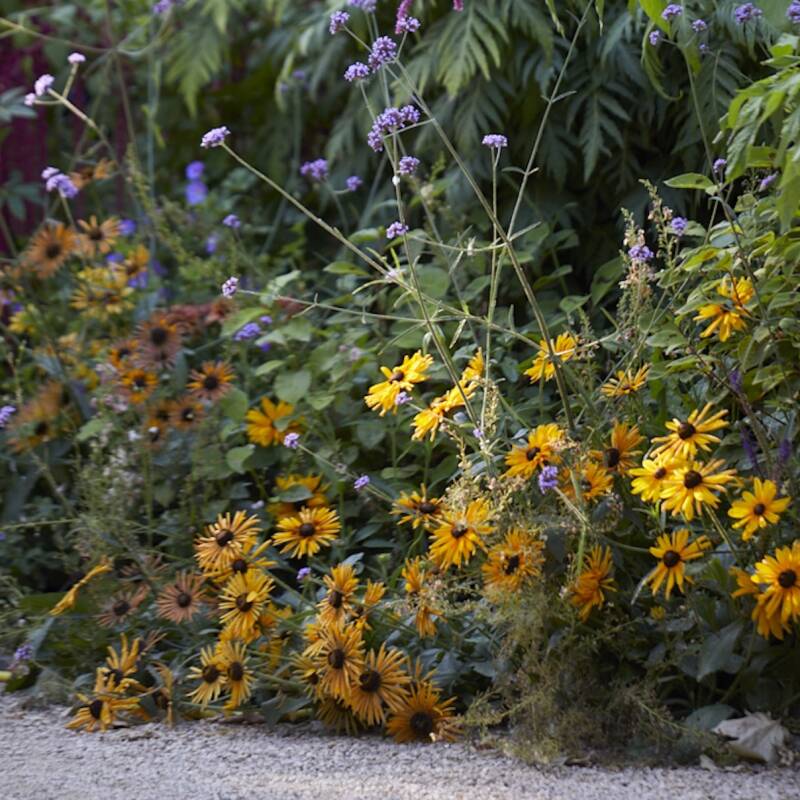
These photographs were taken just after planting and it is easy to see what Matt Pottage means when he says that the park is about slow gardening. “We never intended this to be the Chelsea Flower Show on day one. These plants will be slower to establish. And when you’re planting into harsh conditions with a high [alkaline] pH, plants must go in small to adapt. So this will take time.”

So, what does the public think? Matt reported back that on opening day there were 4,000 visitors, including a woman who brought a cardboard cut-out of a smiling Queen Elizabeth II. Despite the ecological value of the garden and the aim for longterm resilience, it is also intended as a spectacle for visitors; another prized piece in the mosaic that makes up the Regent’s Park (and the famous rose garden is just two minutes away). “Parks are for people” says Matt. “But a garden isn’t finished on the day it opens. It’s just the start, and this one has been designed with that firmly in mind. We hope it will become more and more beautiful as time goes on. The horticultural ambition here is what is so exciting.”
See also:
- A Duchess and Her Tulips: Spring Bulbs at Badminton
- The Gardener King: The New British Monarch’s Passion for Sustainable Gardening
- Cow Parsley: An English Weed with Royal Connections




Have a Question or Comment About This Post?
Join the conversation