If there’s one way to spot an American abroad when visiting their house or garden, it’s in the design efficiency. Just as Americans introduced heat and comfort to English country houses a hundred years ago, so Dan and Catherine Desmond’s American background is betrayed by the 1,000-liter water tank and bespoke gutters at their house in the Cotswolds. A new build that was shoehorned into the back alley of a very pretty and ancient market town, it is also rather different from its neighbors in the way the garden looks.
Catherine is a keen and knowledgeable gardener (she is British, while her husband is American; they both worked in Pennsylvania state government for many years). The plot around their new home had been the walled garden to a grand house and there were some fruit trees left over, but otherwise it was waiting for a plan. Catherine knew she wanted the garden to serve the greater ecosystem, of which she and her husband were only a part. She also knew that at 79, she didn’t want to waste time with mistakes, so she called in our friend, the garden designer James Alexander-Sinclair. Their working relationship was collaborative. The first thing they did was put in a pond, which takes up to one-third of the garden.
We went over for a visit.
Photography by Britt Willoughby.
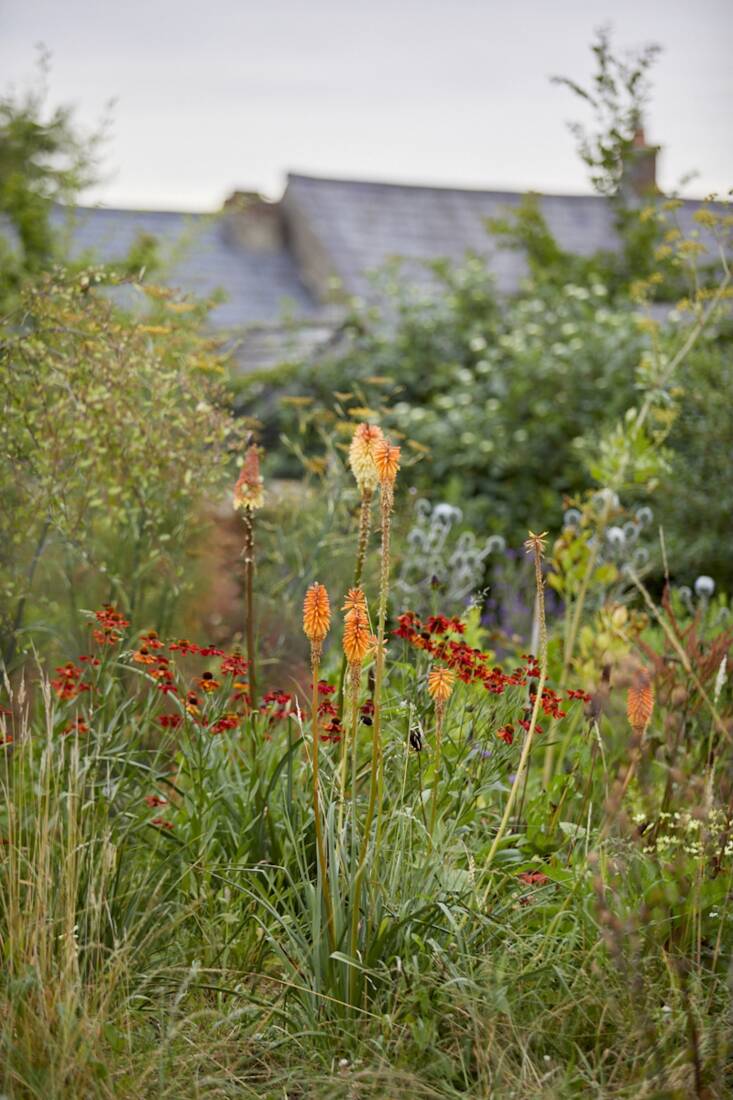
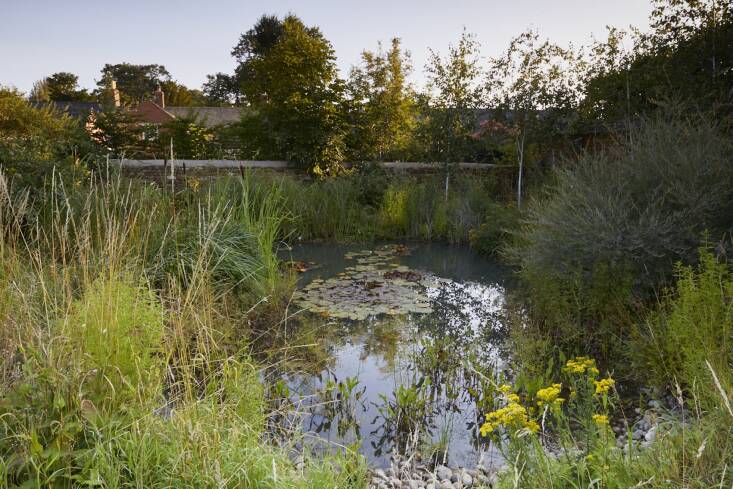
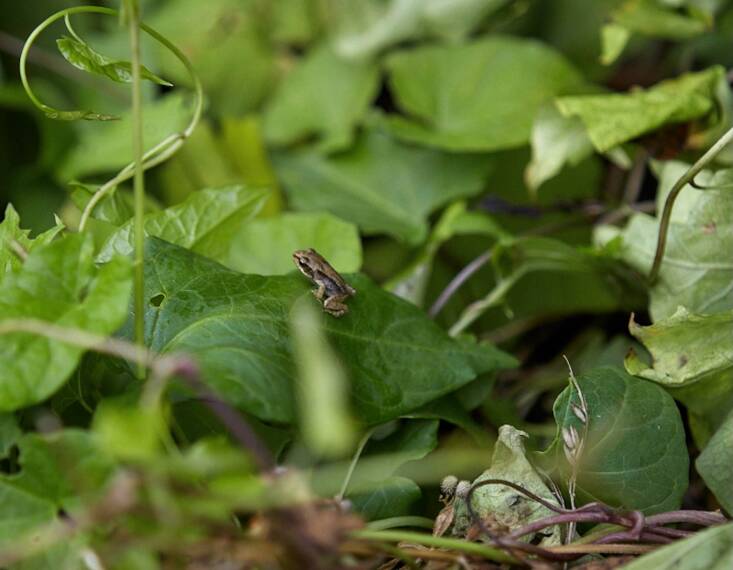
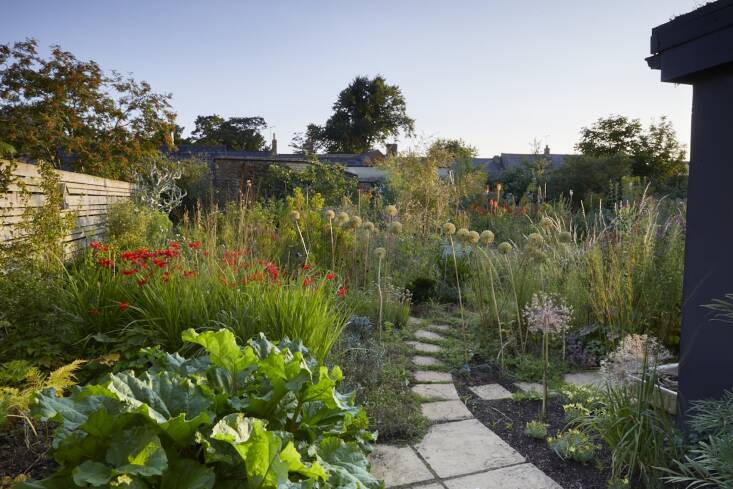
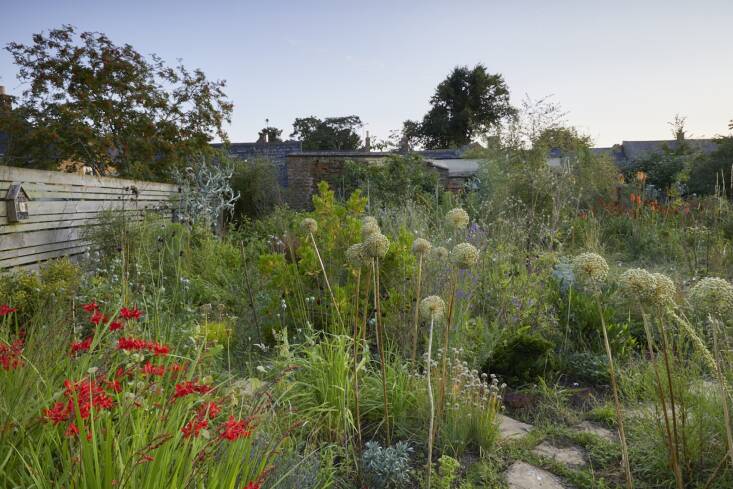
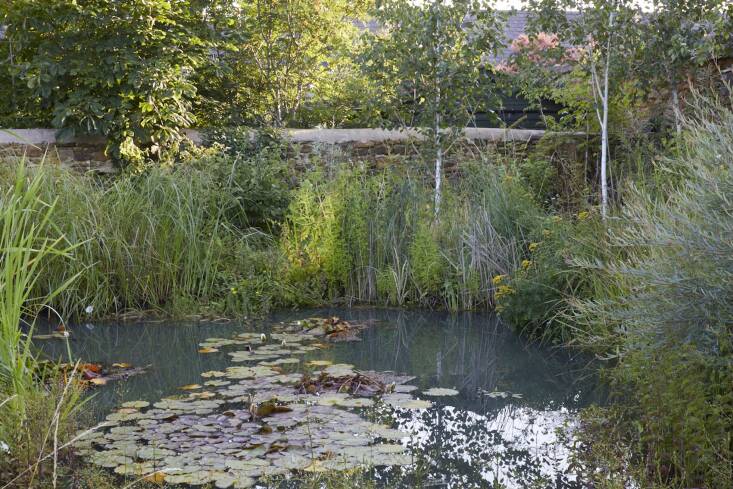
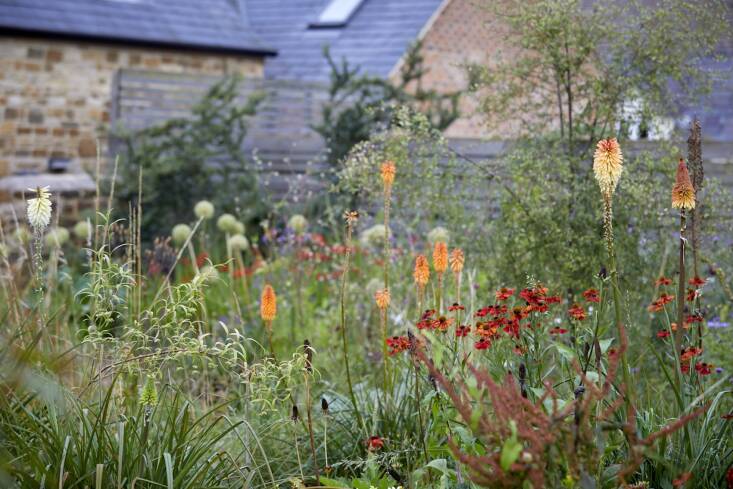
Above: Catherine describes the garden’s composition as “a pond, a wild bit, a garden-y bit, and an eating bit.” Kniphofia in its many varieties features strongly in the garden-y bit, shown here with Helenium ‘Moorheim Beauty’. Kniphofia’s strappy leaves lose themselves amid grasses; weeds are moved out of the way when new plants come in. Above: James sums up the garden implementation thus: “We built a very large pond as a first step, and then layered the planting in amongst the tussocky wild grasses, thistles, bindweed, et cetera. Catherine does weed but is not ruled by the need to.” Catherine: “I brought in James to stop me from making horrible mistakes. I didn’t have time to make mistakes.” Above: Shown here, a small frog makes use of the protective cover of bindweed. “The principle behind the garden is one of living with the weeds rather than fighting against them,” says James. “Anything that comes in is welcome to stay,” says Catherine, although she does have a few caveats, including ground elder. The prominent pond provides drama and theater. “There are dragon and damsel flies, frogs, and all kinds of living creatures that have made the pond their home,” says Catherine. Above: The gutters, just in view on the right, are a point of pride for Dan. “We both have a fairly deep background in green building design and energy conservation, alternative energy, and energy efficiency.” Therefore, the gutters work: “They can drain through a very long way away because they are seamless, and no debris gets in because of screens on top.” The storage tank is for irrigation but its overflow also feeds the pond. When the pond fills, an underground soakaway (dry well) also keeps rainwater on site, instead of adding to the pressure of drains.
Above: Catherine persuaded James that she wanted the planting to be put in as screens, changing the perspective as you move around it, while adding a sense of depth. “He went along with what I was doing,” says Catherine. “When he came back the next year, he wandered through, muttering, ‘It is a garden. It really is. An eccentric one, but it’s a garden.’ I think he was surprised.” Above: Of the client-designer relationship, Catherine recalls: “Very often it was a case of me saying, ‘This is what I want. Can you help me do this?’ So, I would have put in a much too small a pond, and it would have been regular in shape. That was quite bold, putting in such a big one.” Above: Catherine has been interested to see reactions to her garden, in the context of where she is, in the Cotswolds. “Owners of tidy, traditional gardens have said, ‘Ah.’ But an awful lot of people have come in, all sorts of people you wouldn’t expect, like the guy who owns the solar panel company who did ours, and they’ve all said, ‘Oh…!’ And they’re not just the younger folks who seem to get it; it’s some of the older ones, too. I would say it’s been 80 percent positive, actually.”
When you register as a free Member of the Remodelista family of websites (Remodelista, Gardenista, and The Organized Home), you gain access to all current posts plus 10 archived posts per month, our internal bookmarking tool, and the community bulletin board.
Access 10 archived posts (older than one year) per month on each site
Use of our internal bookmark tool, so you can save products, posts, and other pages for quick reference
Access to our community bulletin board so you can ask and answer design-related questions
Unlimited access to the Product Catalogs, Design Travel sources, and Architect & Designer Directory listings
Choose from our ten newsletters to keep up with the latest on the sites
Or Subscribe for Maximum Value!
For $5/month ($59.99 paid annually) you'll enjoy unlimited, ad-free access to Remodelista, Gardenista, and The Organized Home and all the benefits of Membership.
Annual subscribers pay 50% off the monthly subscription price of $9.99
×
Subscribe to the Remodelista family of websites
For $5/month ($59.99 paid annually) you'll enjoy unlimited, ad-free access to Remodelista, Gardenista, and The Organized Home and all the benefits of Membership.
Annual subscribers pay 50% off the monthly subscription price of $9.99
×
Sorry! As a registered member you get 10 free posts from our archive (posts more than a year old) every 30 days. You have reached your limit for this 30-day period. If you would like to access unlimited posts from the archive (ad free, too), become a subscriber today, and keep reading as many articles as you want.
Full Access Individual Subscription
Benefits include:
Unlimited access to Remodelista, Gardenista, and The Organized Home sites
Ad-free browsing environment
Unrestricted access to 30,000+ archived posts
Receive the full-text daily newsletters
All features that Members have access to
Annual subscribers pay just 50% off the monthly subscription price of $9.99
Sorry! You have reached your limit of three (3) free posts from our archive every 30 days. You can increase this to 10 posts by joining as a free Member, or read unlimited posts with no ads by becoming a paid Subscriber.
Subscribe to the Remodelista family of websites
For $5/month ($59.99 paid annually) you'll enjoy unlimited, ad-free access to Remodelista, Gardenista, and The Organized Home and all the benefits of Membership.
Annual subscribers pay 50% off the monthly subscription price of $9.99
Become a Member at no charge
When you register as a free Member of the Remodelista family of websites (Remodelista, Gardenista, and The Organized Home), you gain access to all current posts plus 10 archived posts per month, our internal bookmarking tool, and the community bulletin board.
Congratulations on becoming a Subscriber to Remodelista, Gardenista and The Organized Home! You now have access to many great features across the sites:
Unlimited access to all three sites
Ad-free browsing environment
Unrestricted access to 30,000+ archived posts
Receive any of the newsletters, including the the full-text daily Remodelista and Gardenista newsletters
Use of our internal bookmark tool, so you can save products, posts, and other pages for quick reference
Access to our community bulletin board so you can ask and answer design-related questions
Congratulations on joining as a free Member of Remodelista, Gardenista and The Organized Home! You now have access to many great features across the sites:
Access to all posts published in the past year
Access 10 archived posts (older than one year) per month on each site
Use of our internal bookmark tool, so you can save products, posts, and other pages for quick reference
Access to our community bulletin board so you can ask and answer design-related questions
Unlimited access to the Product Catalogs, Design Travel sources, and Architect & Designer Directory listings
Choose from our ten newsletters to keep up with the latest on the sites
If at any time you want to become a Subscriber and enjoy unlimited, ad-free access to all our content, just go to the My Account link and choose Subscribe.
We use cookies to ensure that we give you the best experience on our website. If you continue to use this site we will assume that you are happy with it.







Have a Question or Comment About This Post?
Join the conversation