

When I spotted a scale insect on a leaf of my Thai lime tree recently, I sighed. It’s only December; sometimes they show up only in March. We must coexist indoors for another five months. I had been led to peer closely at the tree’s leaves by a tell-tale spattering of sticky honeydew beneath one branch. Above it, two branches up, I found the culprit, the pale brown dome of a mature scale insect. Wondering what other indoor plant pests are vexing the houseplant community, and how they deal with them, I consulted Darryl Cheng, Toronto-based creator of The House Plant Journal and the author of two popular books on indoor plant parenting. Darryl’s meticulous approach to growing plants is at once accessible and realistic. His engineer’s perspective to plant care includes the encouraging maxim that having a green thumb “isn’t about luck, but about being observant.”
Let’s observe. Here’s an alphabetical hit list of six of the most common indoor plant pests you may find feasting on your botanical babies: Aphids, fungus gnats, mealy bugs, scale, spider mites, and thrips—and how we deal with them.
Photography by Darryl Cheng and Vincent Mounier.
Darryl points out that what many of us call indoor or houseplants “are in fact tropical foliage plants” (or subtropical in some cases, like my Thai limes). Understanding how to get them to thrive in our controlled indoor climates means approximating their natural growing conditions in terms of light, moisture, and temperature. Even then, over time, they will be visited by tiny creatures that feed on them and do damage: indoor plant pests. These insects and arachnids (spider mites have eight miniature legs) may travel indoors with an indoor-outdoor plant, or (very commonly) they arrive with a newly-acquired plant. They are part of the plant’s life. And while checking your leafy family members daily may seem like a chore, it is essential for their health and “also kind of therapeutic,” Darryl says. “Think of it as detailing your plant.”
His philosophy for his own plants is that nature should be allowed to take its course. Indoor plant pests are tolerable at “the lowest level possible, as long as the plant is strong.” Here is how to keep that pest level low.
Aphids
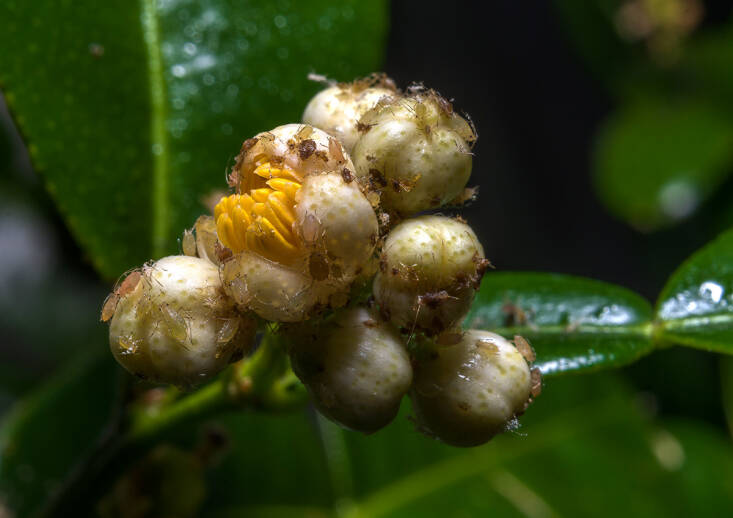
I was a little jealous to learn that Darryl rarely, if ever, encounters aphids. This is likely because they are often an outdoor-indoor issue: In my case, these soft-bodied sap suckers hitch a ride on our trees when we move them indoors for winter. They damage new, tender growth if they remain unobserved for a while, as in my case, above. They can be spotted “when they congregate around the growth point of the plant,” Darryl notes.
Aphid Control:
- I deal with aphids by squishing them. Gross, but effective.
- I also spray them with a mixture of water and dishwashing liquid (1/4 teaspoon in 16 fl oz/2 cups); the soapy coating smothers them.
Fungus Gnats
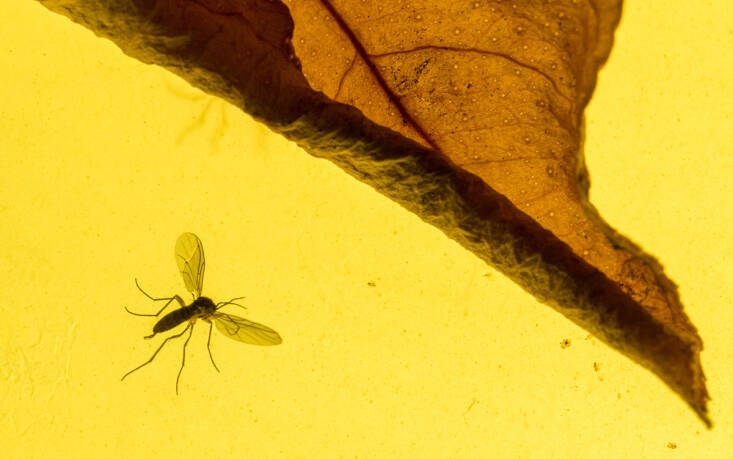
Many online plant forums are abuzz with questions about annoying, small flying insects. Like fruit flies, but different, say the worried houseplant owners. “Fungus gnats are opportunists,” says Darryl, who does not consider them damaging. They feed on fungus that grows in damp organic material, like potting soil or bark chips. Major larval infestations may damage plant roots if no fungus is available. And while I interpret their presence as a timely warning that my potting media for citrus trees is too damp—meaning that I am watering too often—Darryl makes the point that some plants, “like maidenhair ferns,” should remain moist. So the presence of fungus gnats does not necessarily mean that there is problem: “It depends on the plant,” he says, and an understanding of the different conditions that particular plants require to flourish.
Fungus Gnat Control:
- Sticky traps are an effective and non-toxic way to trap adult (flying) fungus gnats. This prevents them from reproducing.
- Allowing pots to dry out reduces gnat numbers by compromising their food source, but not all plants will tolerate dry soil.
- A soil drench of hydrogen peroxide can be effective in treating fungus gnat larvae living in the potting media. The drench is one part 9% hydrogen peroxide to 6 parts of water. Water the plant with the drench (it fizzes satisfyingly while you do this). Because this treatment affects other, beneficial microorganisms in the soil, I am unlikely to repeat it unless in an emergency.
- A very effective biological control for fungus gnats is a drop of Bacillus thuringiensis subsp. israelensis (known as Bti)—a bacterium that occurs naturally in the soil; commercially, it is produced by fermentation. Bti is toxic only to fly larvae.
Mealy Bugs
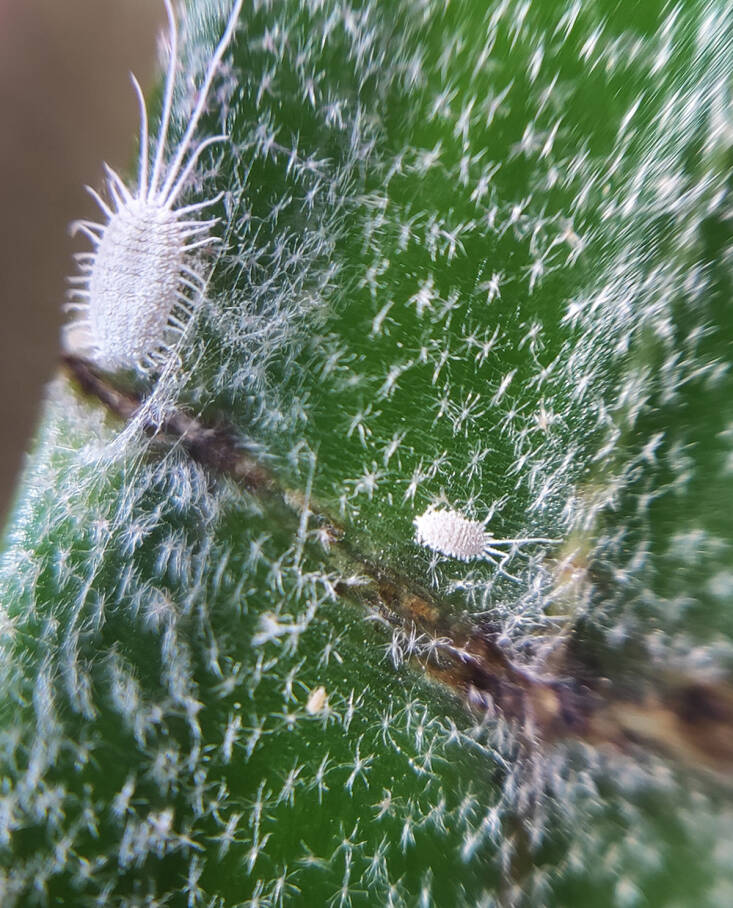
The good news is that mealy bugs are one of the most recognizable indoor plant pests. The bad news is that “even one mealy bug means that there is a nest in or under your pot,” cautions Darryl. Nest? Oh, dear. If you see a fluffy white adult mealy bug, it’s time for a very close inspection of your plant’s living quarters: Tip the pot and look under any rim, and also beneath it. Also lift up and look under the plant’s saucer. Mealy bug nests are outside the planting media, not in it. An adult mealy bug is a warning that many more, very tiny mealy bugs at an earlier stage of development are certain to be on the plant. Act fast.
Mealy Bug Control:
- Masking tape. Darryl’s go-to method for controlling mealy bugs is a simple and inexpensive roll of masking tape or a lint roller. “I’m kind of lazy,” he confesses, “and I don’t want it to be a whole ordeal.” So, instead of hefting a plant into the shower for an arduous spray-job, he lint-rolls or spot-treats mealy bugs with a strip of masking tape. “It picks up what I can see, but also small larvae that I can’t.”
- Masking tape can be used on plants with strong, smooth leaves (never on delicate, furry leaves, like some begonias, which would rip) to roll up not just adult mealy buds, but to gather their numerous and very tiny offspring.
- Nests? Physically remove, then spray and rinse the nests off your pot or saucer with soapy water or insecticidal soap.
- Prevention is easier than the cure: Check your plant daily.
Read Darryl’s full tutorial on mealy bugs.
Scale
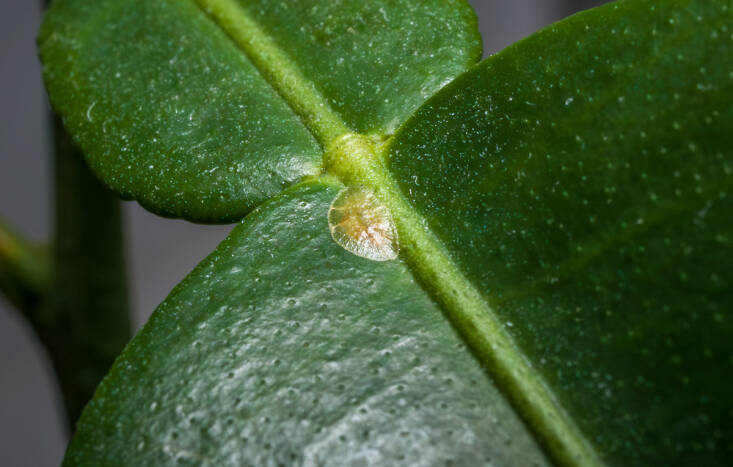
Scale insects are my personal plant nemesis. Nemeses? The first clue that you have scale, says Darryl, “is little drops of a sticky substance on random places under the plant,” as well as on a plant’s leaves. (He notes that some plants, like Philodendrons, have extrafloral nectaries—quite normal, and not a sign of scale.) Another, usually outdoor, sign that scale is present, is a line up ants moving up and down your plant. That should have been a warning to me in summer, when I noticed them on our terrace, “farming” the scale insects for their sweet honeydew. (Outdoors, on a healthy plant, natural predators like lacewings, ladybugs, and feasting birds can keep scale under control.)
Read more about my indoor citrus care here.
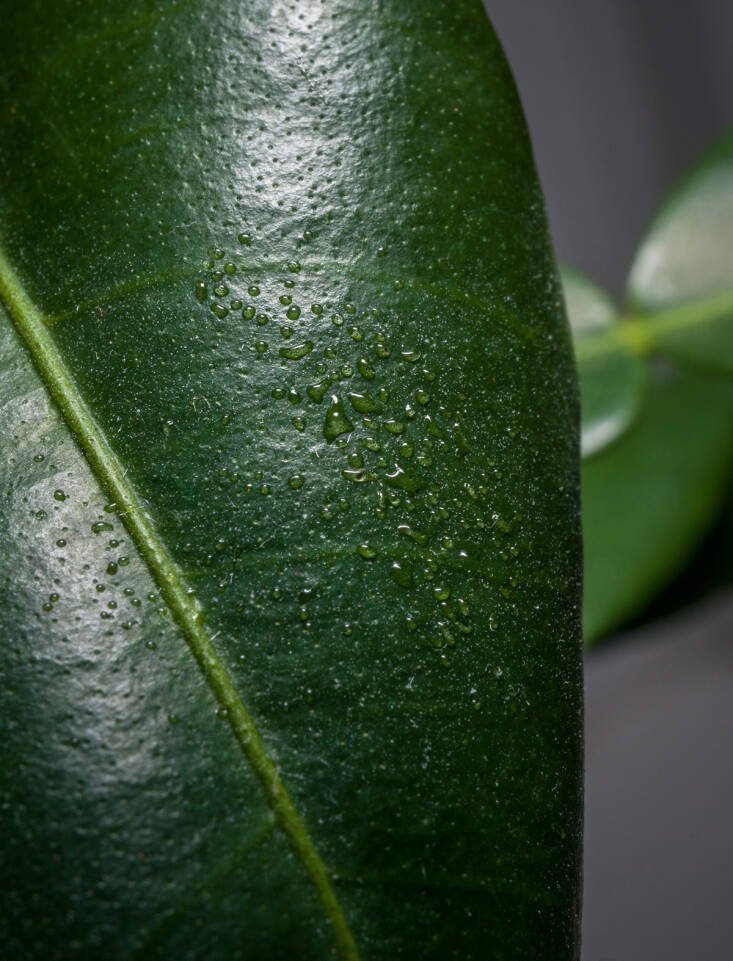
To find scale insects, follow a vertical line up from where you see honeydew on a surface or on the plant’s leaves. It can take some hunting. “Some species of scale are prominent, but some are pale and hard to see,” says Darryl. But find them you must, because under those domes are eggs and “crawlers,” the mobile stage of scale insects, and “these can hatch every couple of days,” he says. For Star Wars fans, Darryl’s vividly alarming analogy is picturing them “like hordes of TIE Fighters being released.”
Not sure I’ll sleep at night now.
Scale Control:
- For heavy infestations that have escaped notice, Darryl recommends cutting off affected foliage.
- Masking tape, because “it picks up the domes but also the crawlers.”
- Tweezers: for spot treatment, Darryl likes to use needle-nosed tweezers to remove domes.
- Squashing: That’s my tip, but I now add Darryl’s masking tape trick to catch tiny crawlers.
- A soapy sponge washed over leaves is effective, in my experience.
- Neem: I treat my trees with a Neem spray (in the shower) when I can’t reach the many leaves of a healthy citrus tree, with a follow-up after three days.
Read more about scale in Darryl’s tutorial.
Spider Mites
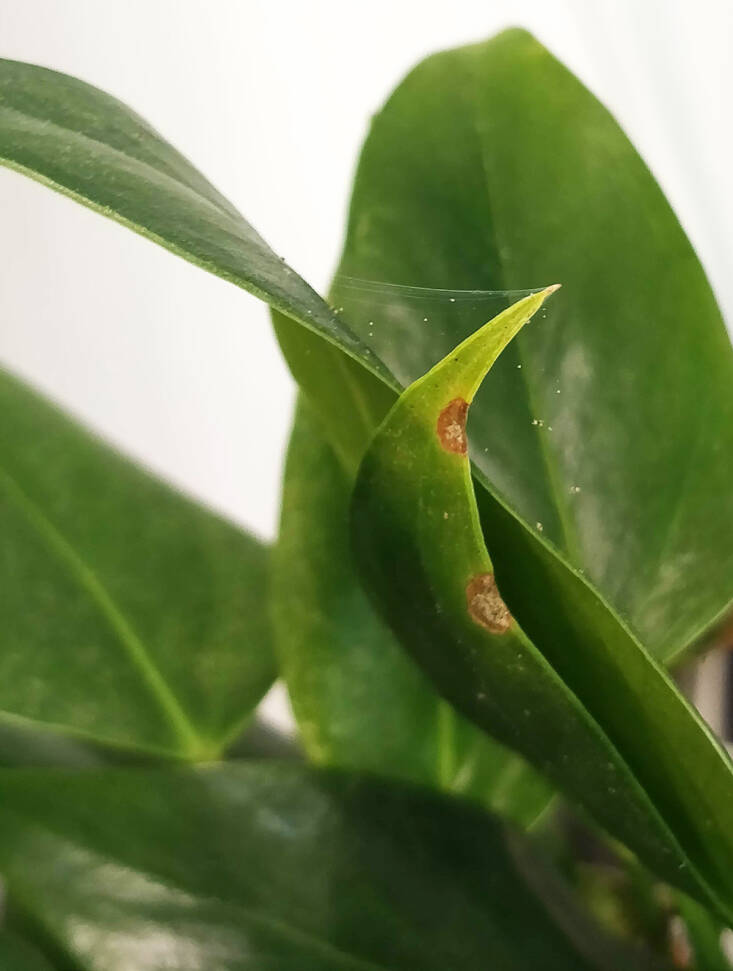
Fine cobwebs on your indoor plants might be the innocent traps created by a harmless indoor spider (these webs are beneficial for trapping fungus gnats), but they might also indicate an extremely common indoor plant pest: the spider mite, a tiny arachnid whose needle-like mouth parts pierce plants as they feed on sap. If you manage to see a web backlit, you might spot the miniature creatures moving back and forth on it. Also check the leaves, says Darryl. “Their eggs and first level instar [they only have six legs versus the eight of the adult] remnants remain on the plant, especially on a vein or in a crevice, resembling grains of salt.”
Spider Mite Control;
- Lint roller or masking tape pick up all stages of the spider mites.
- Insecticidal soap treats the whole plant.
- A session in the shower will dislodge and drown spider mites.
Thrips
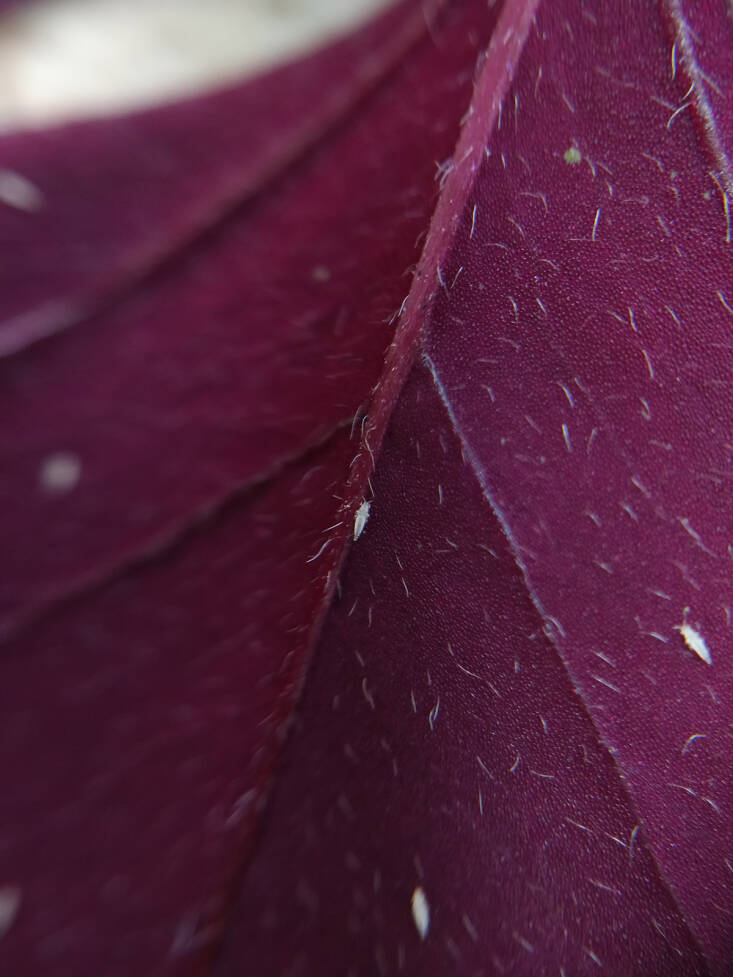
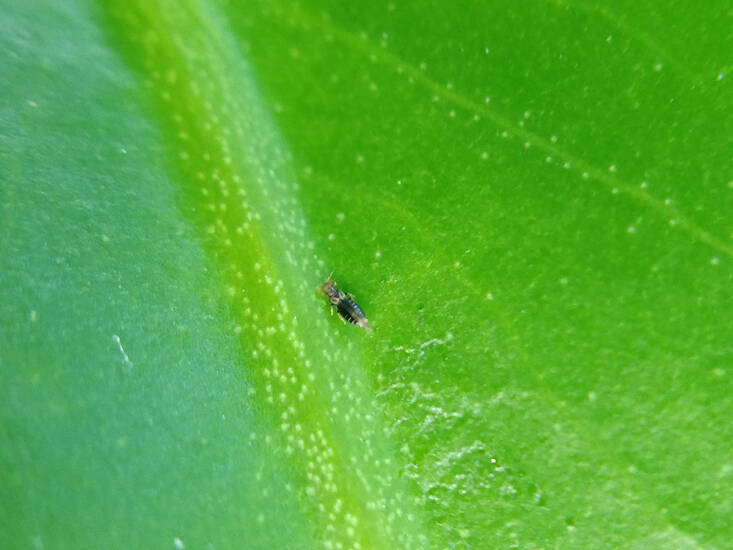
Thrips are one of the most pernicious of indoor plant pests and plagued Darryl’s indoor collection so much over a three-year period that he had to discard some of his plants. They eat plant tissue, leaving scratch-like silvery marks, leading to dead leaves. What can make thrips very hard to control is that “their eggs are inside the plant tissue,” he says, rather than on it, “making spraying useless.”
Thrips Control:
- Cutting off affected leaves: “this guarantees control” of an infestation, he notes.
- Manual removal using masking tape will catch the rice-grain stage as well as adults.
- Repeat treatment is essential since the eggs remain in the leaves and will hatch, so disrupting their life cycle is important.
- Insecticidal soap (not dish soap) in conjunction with physical removal.
Read more about the signs of a thrips infestation in Darry’s tutorial.
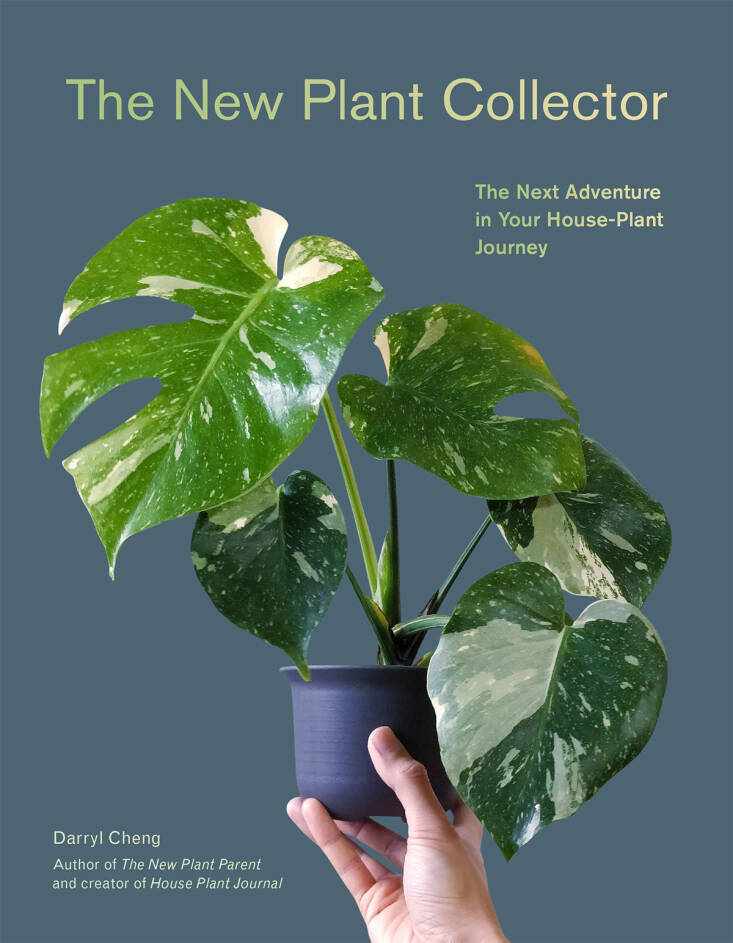
Darryl Cheng’s latest book, The New Plant Collector—The Next Adventure in your House Plant Journey, is $14.15 on Amazon.
See also:
- Winter Is Coming: How to Care for Houseplants When They Go Dormant
- Move Over, Monstera—The Year’s New Houseplant Trends
- 9 Best Practices for Sustainable Houseplants





Have a Question or Comment About This Post?
Join the conversation