Icon - Arrow LeftAn icon we use to indicate a rightwards action. Icon - Arrow RightAn icon we use to indicate a leftwards action. Icon - External LinkAn icon we use to indicate a button link is external. Icon - MessageThe icon we use to represent an email action. Icon - Down ChevronUsed to indicate a dropdown. Icon - CloseUsed to indicate a close action. Icon - Dropdown ArrowUsed to indicate a dropdown. Icon - Location PinUsed to showcase a location on a map. Icon - Zoom OutUsed to indicate a zoom out action on a map. Icon - Zoom InUsed to indicate a zoom in action on a map. Icon - SearchUsed to indicate a search action. Icon - EmailUsed to indicate an emai action. Icon - FacebookFacebooks brand mark for use in social sharing icons. flipboard Icon - InstagramInstagrams brand mark for use in social sharing icons. Icon - PinterestPinterests brand mark for use in social sharing icons. Icon - TwitterTwitters brand mark for use in social sharing icons. Icon - Check MarkA check mark for checkbox buttons.
You are reading

Required Reading: ‘A Year of Cut Flowers’ by Sarah Raven

Search

Required Reading: ‘A Year of Cut Flowers’ by Sarah Raven

April 8, 2026

“I know many gardeners share this feeling: cutting flowers is stealing the view and that splendid delphinium, huge pom pom peony, or lupine spear are best left growing outside,” writes world-renowned gardening expert and best-selling author Sarah Raven in her new book, A Year of Cut Flowers: A Life of Growing and Arranging for All Seasons. But if you select the right types—annuals, biennials and dahlias—and pick them correctly at the right time, she says, you actually promote bud formation and create the potential for more flowers. Her credo is: the more you pick, the more they flower.
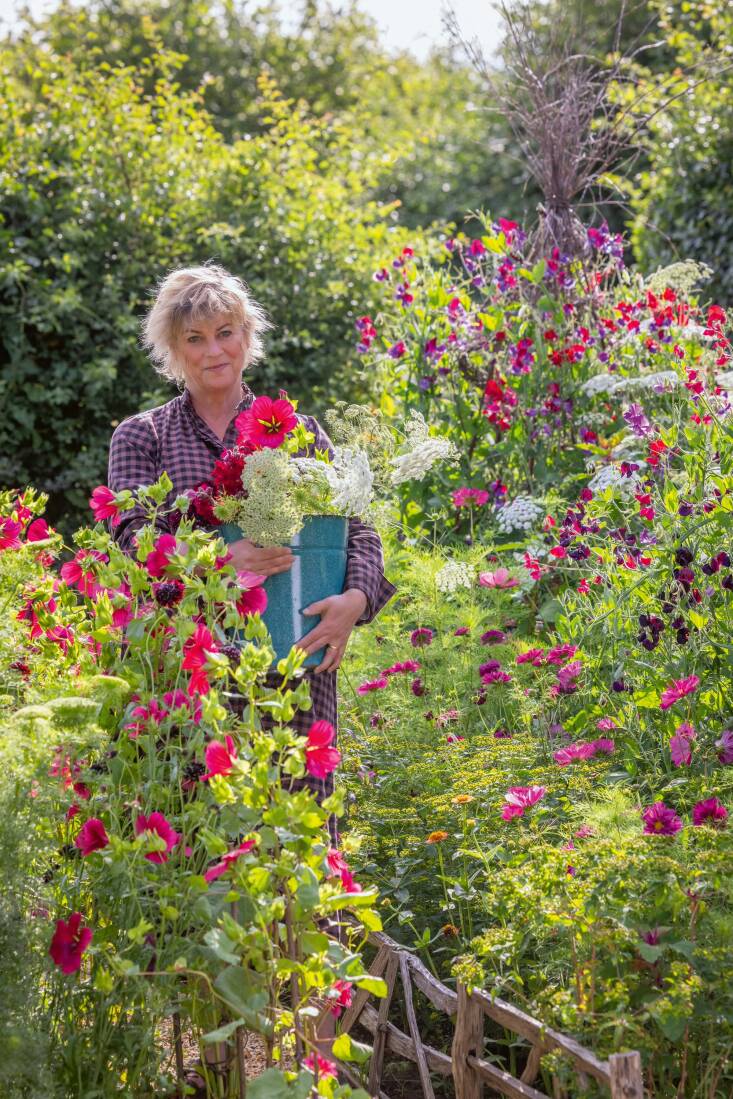
Sarah Raven with a bucket of cut flowers in her cutting patch. Photograph by Jonathan Buckley.
Above: Sarah Raven with a bucket of cut flowers in her cutting patch. Photograph by Jonathan Buckley.

It’s true that Sarah has no formal floral training, but that means little when you consider she’s had decades of hands-on experience and is the author of 14 books on gardening. To us, she describes herself as “an enthusiast who’s restless yet quite grounded, hard-working and creative, and most at ease in nature with good friends and family, not at a party.”

The rose trial bed at dawn with Rosa &#8\2\16;Rhapsody in Blue&#8\2\17; syn. R. &#8\2\16;Frantasia&#8\2\17; in the foreground. Digitalis purpurea &#8\2\16;Sutton&#8\2\17;s Apricot&#8\2\17; and Papaver somniferum poke their cheery heads out. Photograph by Jonathan Buckley.
Above: The rose trial bed at dawn with Rosa ‘Rhapsody in Blue’ syn. R. ‘Frantasia’ in the foreground. Digitalis purpurea ‘Sutton’s Apricot’ and Papaver somniferum poke their cheery heads out. Photograph by Jonathan Buckley.

Over the years Sarah’s obsession with cut flowers has literally and figuratively grown. A Year of Cut Flowers is the culmination of all those decades of planting, growing, picking, assessing, and arranging almost every day (these days with the help of five talented team members): As such, you’ll find plenty of cut flower inspiration and practical advice in the book. In addition, Raven shares how she decides what to grow in the first place, how many to plant, and which plants should be the backbone of any cutting garden, regardless of the size of your garden plot. “There are high-production groups which give you a lot from a little,” she explains. In the book, Sarah also answers everyone’s perennial question about cut flowers: how to make them last. (Her cardinal rule: “don’t pick and plonk. Instead, pick, condition, rest and then arrange.”)
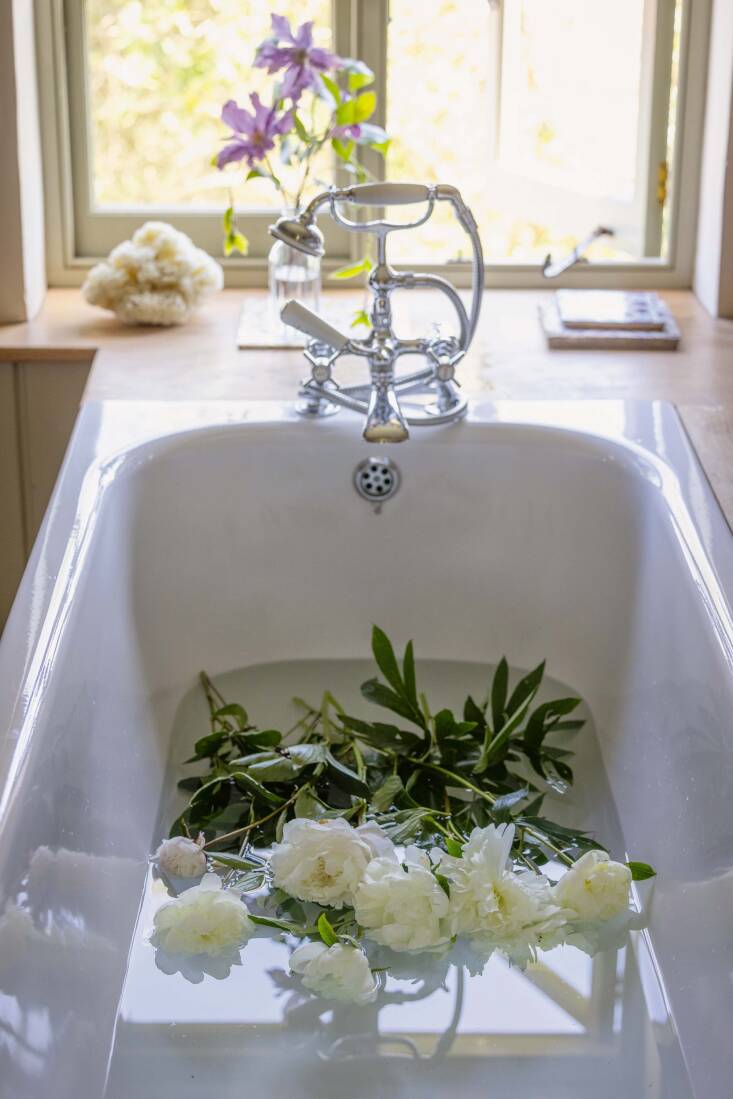
A new-to-me concept that I learned from her book is to submerge certain plants before arranging, such as hydrangeas, peonies, and hostas. Here Paeonia lactiflora &#8\2\16;Duchesse de Nemours&#8\2\17; is being conditioned in a bath. Photograph by Jonathan Buckley.
Above: A new-to-me concept that I learned from her book is to submerge certain plants before arranging, such as hydrangeas, peonies, and hostas. Here Paeonia lactiflora ‘Duchesse de Nemours’ is being conditioned in a bath. Photograph by Jonathan Buckley.

As a devoted fan of growing cut flowers and making flower arrangements, I got giddy reading her book and learning which were the cut-and-come-again plants and which were the easy, top-production cut flowers. I had to ask: which flowers were her favorites? Raven graciously obliged. “Anemones—they flower so very early. Dahlias—they are easy to grow and for their sheer abundance, plus new breeding gives extended vase life. Snapdragons—they provide texture, vase life, and wonderful shapes.”
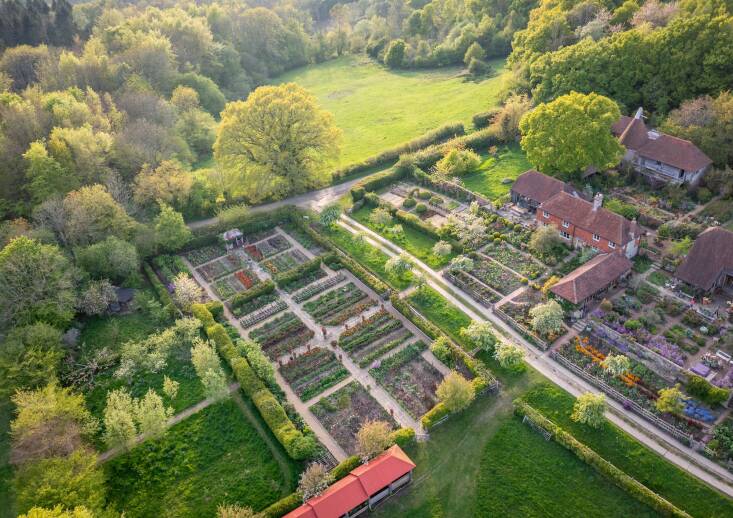
An overhead view of the orderly and productive gardens at Perch Hill in spring. Photograph by Jonathan Buckley.
Above: An overhead view of the orderly and productive gardens at Perch Hill in spring. Photograph by Jonathan Buckley.

More than learning the details of planting and cutting, including the notion of growing plants for foliage to add form to an arrangement, her inspiring book is a call to action to both plant something today and cut some flowers and bring them in, whether it’s a large bouquet or a single blossom. The act of bringing beauty inside is a positive, simple, and life-affirming experience. Sarah shares with me, “Sow a packet of seed and you’ll see by next week that you have new members of your ‘family’ that you’ll then get to know over the next few months.”
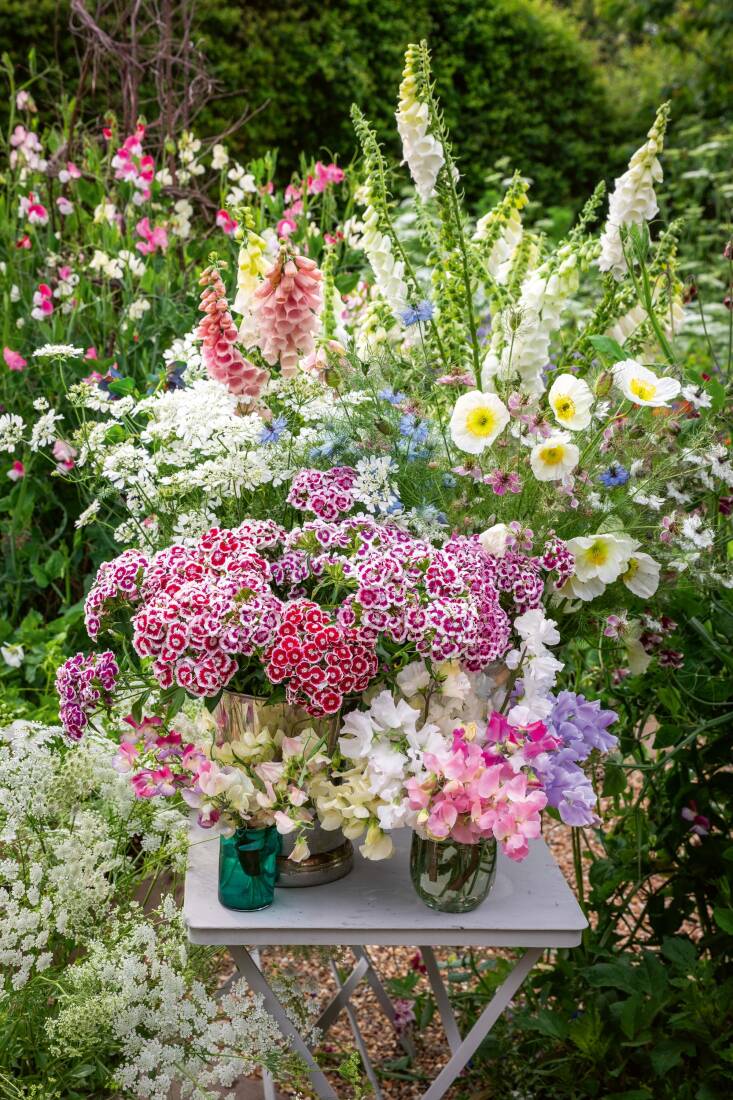
Buckets of June wedding flowers including Dianthus barbatus &#8\2\16;Electron Mix&#8\2\17; &#8\2\1\1; Sweet William; Papaver nudicaule &#8\2\16;Champagne Bubbles Mix&#8\2\17; F\1 &#8\2\1\1; Iceland poppies; Ammi majus &#8\2\1\1; Bishop&#8\2\17;s flower; Orlaya grandiflora &#8\2\1\1; White laceflower. syn. Caucalis daucoides; Caucalis grandiflora; Digitalis purpurea f. albiflora syn. D. alba &#8\2\1\1; White foxglove; and Nigella damascena &#8\2\16;Persian Rose&#8\2\17; &#8\2\1\1; Love-in-a-mist. Fragrant sweet peas burst from colored jars. Photograph by Jonathan Buckley.
Above: Buckets of June wedding flowers including Dianthus barbatus ‘Electron Mix’ – Sweet William; Papaver nudicaule ‘Champagne Bubbles Mix’ F1 – Iceland poppies; Ammi majus – Bishop’s flower; Orlaya grandiflora – White laceflower. syn. Caucalis daucoides; Caucalis grandiflora; Digitalis purpurea f. albiflora syn. D. alba – White foxglove; and Nigella damascena ‘Persian Rose’ – Love-in-a-mist. Fragrant sweet peas burst from colored jars. Photograph by Jonathan Buckley.

For more wisdom, listen to Sarah’s weekly podcast Grow, Cook, Eat, Arrange, which welcomes guests from the world of horticulture and beyond and gives gardeners the knowledge and practical skills needed to grow their own dream garden.

See also:

(Visited 79 times, 76 visits today)
You need to login or register to view and manage your bookmarks.

Have a Question or Comment About This Post?

Join the conversation

v5.0