


I came to gardening, as many of us do, not necessarily out of a love of the natural world but because of a fascination with flowers. In the beginning, I was attracted to those big, vulgar things so often used as a punctuation mark within a planting scheme: the bright yellow colon of hollyhock or full-stop exclamation point brought by a sunflower’s radial symmetry.
When transitioning to garden design in my late twenties, I would occasionally send photos of floriferous encounters to my grandmother—enormous tree peony blooms at the Brooklyn Botanic Garden, or creamy magnolias from my morning walk to work on the High Line. She was withering on her deathbed from Alzheimer’s, even though in my mind’s eye she will forever be crouched on her knees in the southern sun, toiling in a bed of dark pine mulch, her once-round cheeks surrounded by the acidic zing of wax begonias. The texts were sporadic because I didn’t know how to talk about dying. It occurs to me now that in sending them I was probably, on some subconscious level, hoping to fill her back up.
When I was studying horticulture at BBG, I had a teacher who talked about the first time he actually saw a landscape: not in the literal sense, but as a composition that was made by the sum of its parts. He spoke of how he was able to tease out the nascent forbs from the grasses, to read the silvery underside of certain pioneering shrubs and understand how they were linked to the calciferous earth below. This, I think, is what separates everyday passion from some degree of expertise: an ability to identify and confidently theorize about the minutiae working together to create a larger whole. Strangely, I can’t remember much else about the course, or even what it was.
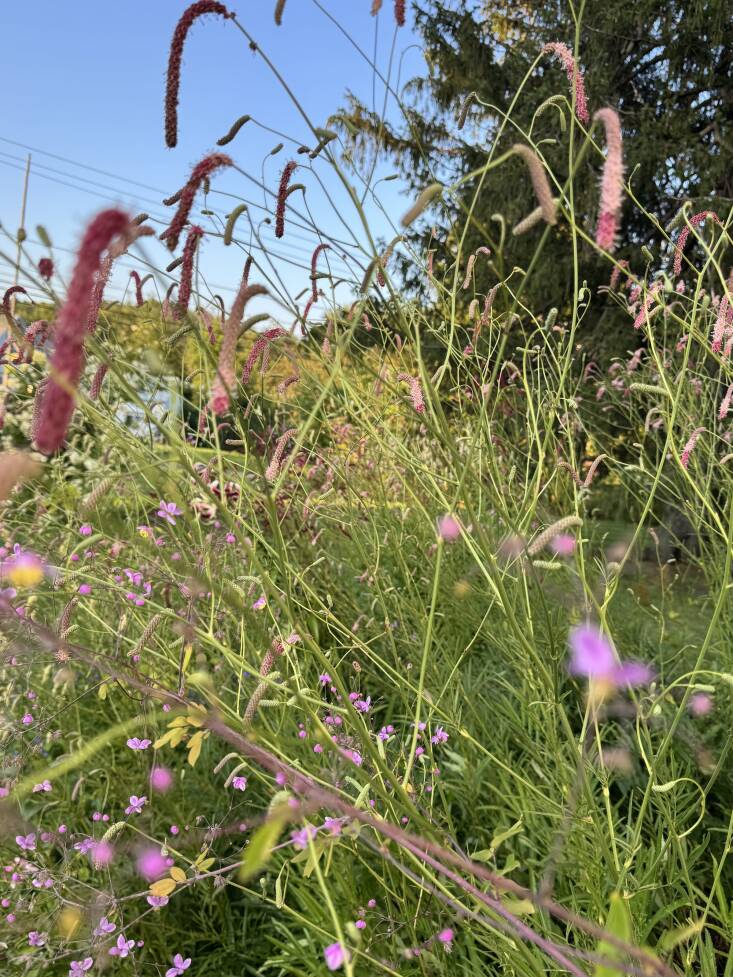
With practice, that ability to zoom in on the details slowly came to me as well. I first spotted the fine, merlot-colored dots of Sanguisorba officinalis peeking out at the very back of some naturalistic garden, hidden between drifts of grass and backdropped by a shock of yellow—maybe Amsonia? I’ve long lost the image, but it’s bookmarked still in my mind, a dog-eared mental page of something I wanted to add to my own garden if and when conditions would allow.
Fortunately, those conditions manifested in a northwest-facing bed in my Massachusetts garden, a small strip of earth that stretches along one side of my driveway. Its aspect and location are challenging—constantly drowned beneath the dripline, baked by gravel, and receiving anywhere from two to eight hours of harsh afternoon sun depending on the time of year. During the time that had passed between that initial sighting of Sanguisorba officinalis and the creation of this bed, my rolodex of the species had grown. Sanguisorba tenuifolia, S. armena, S. obtusa, and their myriad cultivars drifted in my mind, and although not all could or would ultimately make the list, I decided to give many of my favorites a shot.
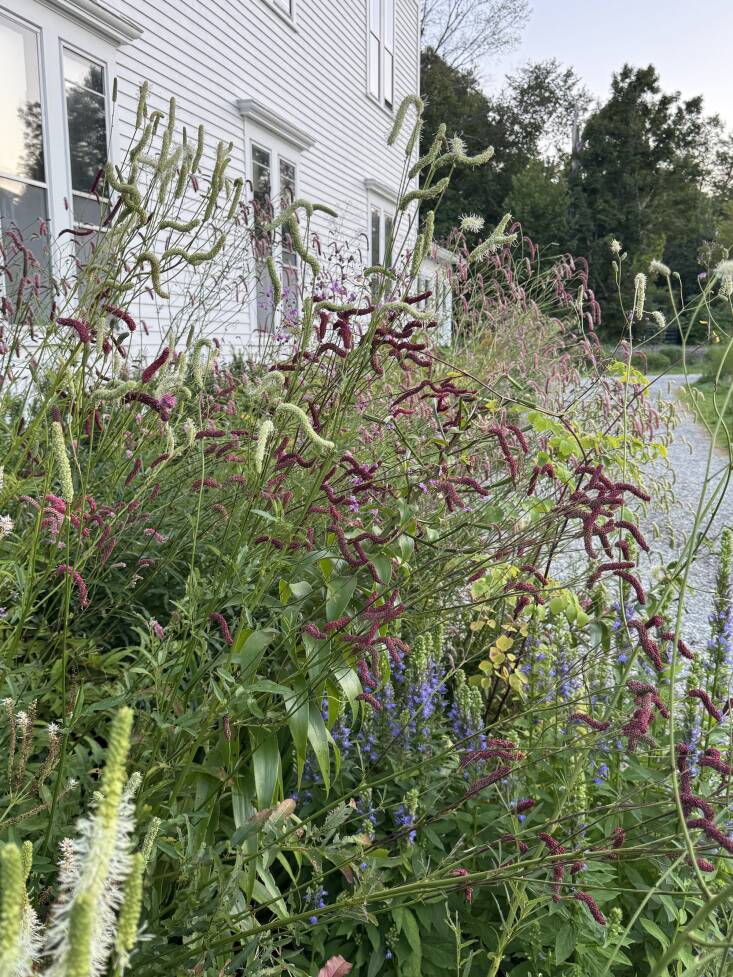
Five years on, the result is one of the most joy-inducing aspects of my garden, even if I still haven’t mastered keeping them upright. Sanguisorba tenuifolia ‘Pink Elephant’, planted at regular intervals, forms giant rounded balls that mimic the rhythm of topiary for much of the season before they splay outward and bolt for the sky in July. The mauve flowers of my S. hakusanensis cultivar charm, with a lightly curved form that gives it its name: ‘Lilac Squirrel’. The flowers of S. parviflora, I think (documentation has not always been my strong suit), are white and lightly scaly, with small, fuzzy stamens that bloom from the tip down. The same unbloomed flowers linger like zingy chartreuse bottlebrushes late into the fall. Mid to late summer, however, is when the whole thing truly sings, each species stretching skyward toward the high summer sun, swaying in the wind amidst clouds of Thalictrum rochebruneanum and swarming bees so profuse that the intensity of their hum is impossible to untangle from the radiating heat that bounces off your skin.
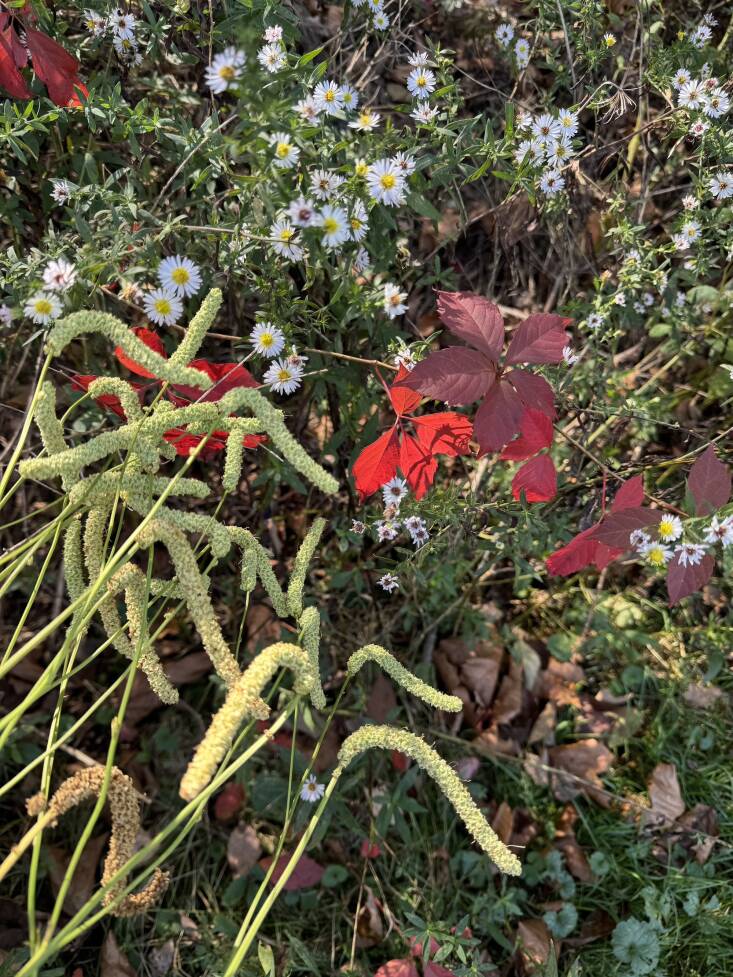
Last fall, I was talking with a gardener who is far more talented and experienced than I am. They pointed to a single plant in their space—Sanguisorba canadensis, I think, since the white flowers were erect like a candelabra—and said they did not know exactly why it was there. There was no use for it in the garden since it resembled, to use their words, “chin stubble.” I appreciated the analogy so much that I’m referencing it here, but I suspect they might feel differently if they scattered a few more around. I kept my mouth shut, schooled as I have been in the polite restraint of Southern manners. There I see a flash of my grandmother again.
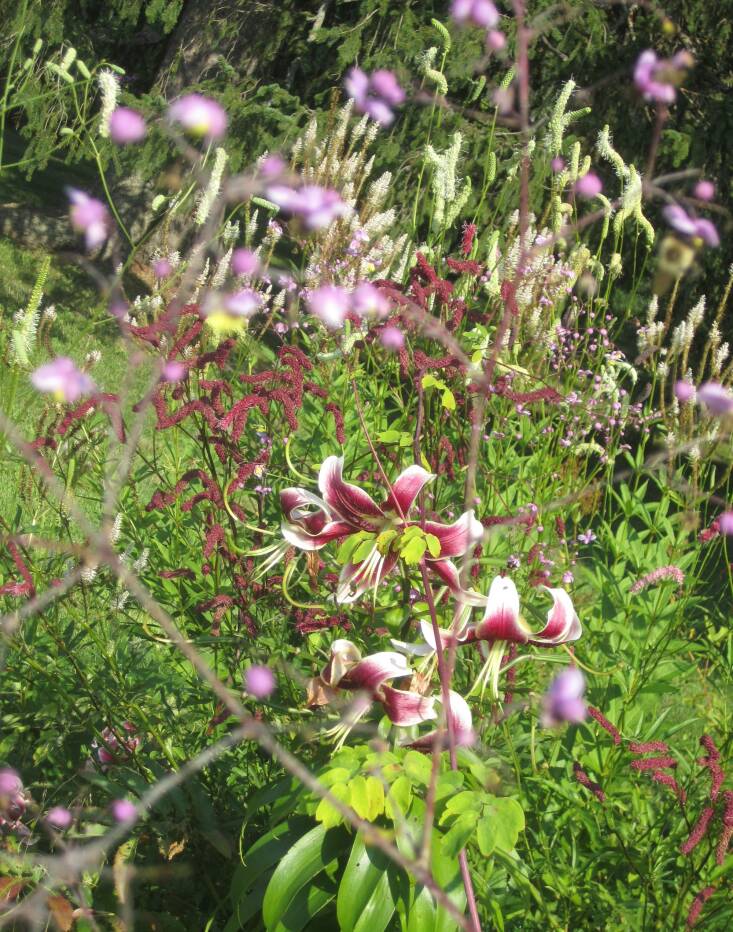
Gardeners are notoriously generous, though there are still secrets each one of us keeps, and here I am laying a few of mine bare: I believe there’s a way things touch heaven just in the act of reaching for it; that real power lies in delicacy; that I have found joy in painting diaphanously—sweeps of washed-out watercolor providing the indelible quality we call spirit and forming a crucial counterbalance to their corporeal counterparts. I have not mentioned that there are many lilies, too, in that northwest-facing bed of mine. The bold, reflexed petals of ‘Scheherazade’ and ‘Black Beauty’ and ‘Fairy Morning’ are also present in late summer, but they would just rest there, listless, if it wasn’t for the Sanguisorba. They are the paper on which so many of those punctuation marks I first fell in love with rest.

Here are a few Sanguisorba resources I found useful (thank you, Taylor):
- “The Best Plant You’re Not Growing” courtesy of the Chicago Botanic Garden.
- A mind-numblingly long list of various cultivars, courtesy of the RHS.
- Issima, for a delightful selection of cultivars for New England gardeners.
See also:
- Rethinking Native Gardens: Beyond Wildflower Meadows
- Rethinking Mugwort: There Is a Lot to Love About This Demonized Herb
- Rethinking Occasional Outdoor Lighting: A Kinder, Gentler, More Nature-Friendly Glow



Have a Question or Comment About This Post?
Join the conversation