

Indoor citrus trees are trending. The proliferation of portable trees—grafted onto dwarf rootstock—makes it possible for almost anyone (with enough light) to grow a lemon, lime, calamansi or kumquat without having a large outdoor space.
With their rise in popularity comes the challenge of citrus care, especially in climates with hard winters, when the subtropical trees either overwinter indoors for months in conditions that can be stressful to the plants (and sometimes to their owners), or live indoors permanently. For these trees, our house and apartment conditions can be challenging, with lower humidity, higher and drier heat, and more difficult watering protocols. Problems can build up sneakily, surprising us and threatening the trees we love.
Read on to learn what those indoor citrus issues might be, and how to prevent or fix them.
Photography by Marie Viljoen.
1. Citrus trees need very bright light and lot of it
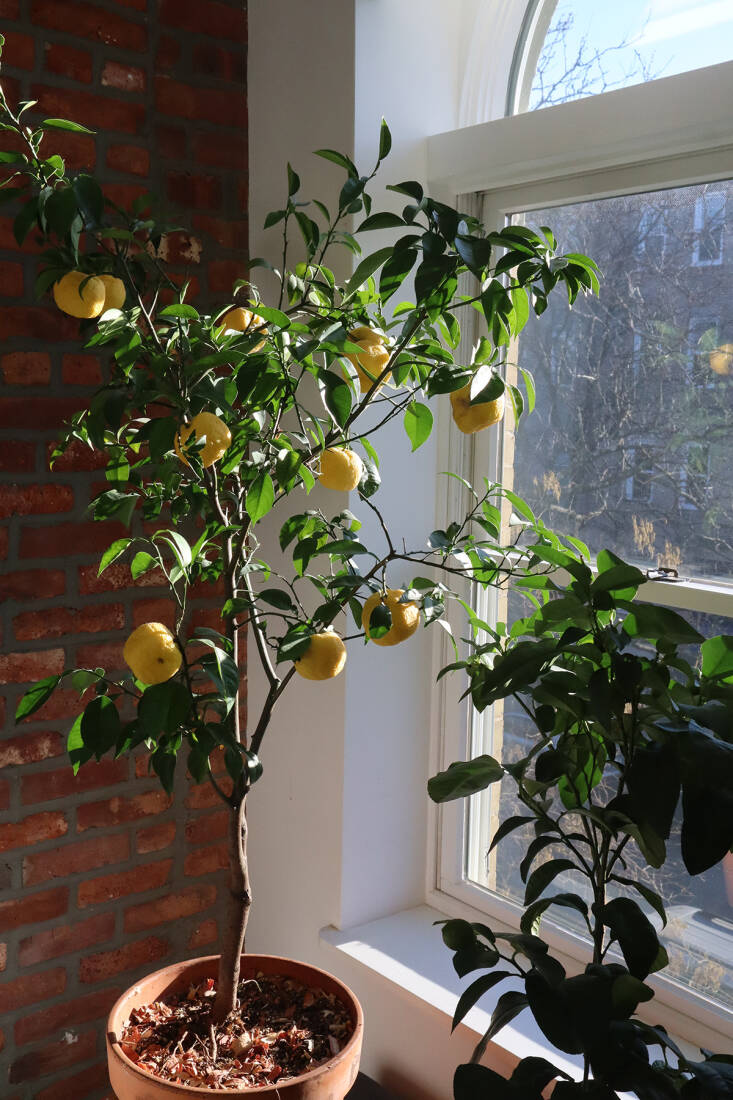
To grow indoor citrus successfully, bright light is essential. In the past, when we have move apartments, I looked at every potential new space through the eyes of my citrus trees. As it were. Would there be sunlight for them? In our south-facing bedroom, there is.
There is a little wiggle room: Whereas a Meyer lemon is uncompromising in its need for a minimum of six hours of sunlight, trees like Thai limes, finger limes, and calamondin (calamansi) are less demanding, because they evolved in semi-shady forest conditions. Bright light (meaning not direct sunlight) will keep them healthy, although they will produce fewer flowers and fruit.
Targeted full-spectrum grow-lights can help those persnickety Meyer lemons, although Aaron Dillon, the fourth-generation citrus grower and owner of Four Winds Growers in California, says that in cases where a tree receives “at least some natural sunlight” during the day, “a simple T-2 fluorescent can provide enough supplemental light.”
Signs of low light: Poor growth; green leaves drop from the tree.
2. Poor drainage kills citrus trees

Planted in pots, indoor citrus require outstanding drainage. Soggy bottoms will kill them. Water must flow right through the pot and out and they must not stand in a saucerful of water.
I mix my potting medium with large handfuls of shredded cedar mulch or orchid bark chips as well as grit. My citrus potting mix has evolved over years from half-and-half soil and chips to one third each of potting soil, orchid bark, and what is known as “chicken grit”- very fine, crushed granite.
The pots have a large drainage hole in the bottom and stand on feet in saucers. If your pots are set inside an ornamental, closed pot, it is imperative that you never allow them to stand in a pool of water. If the water stands for more than an hour, drain it (see No. 2). More work for you, but essential.
Signs of poor drainage: Damp pot bottoms, constantly moist soil, fungus gnats in the room, yellow leaves, drooping, listless leaves, leaves that curl downwards, leaf drop.
3. Overwatering can kill citrus trees

Overwatering is the most common cause of poor indoor citrus tree health. Do water deeply, but only water again when the pot is close to dry. If water in my trees’ saucers touches the bottom of the pot, I let it remain in the saucer for up to an hour hours (thirsty trees will absorb this water again). But after that I suck up excess water with a turkey baster (yes, really).
I also like to use terra cotta pots. If the outside is dark and damp at the base, this is a sign that the soil in the bottom of the pot is too wet (even if the top is dry), which is not good, so I hold off on watering. In terms of touch and feel, the top inch or two of soil will also transition from dark and moist to the touch to lighter and dry. Time to water.
Signs of overwatering: The soil stays moist every day; the bottom of a terra cotta pot looks dark, or green, and is damp to the touch; the leaves are drooping, but not dry and crisp; the leaves gradually turn yellow all over and drop; the presence of fungus gnats indicate that the pots are staying moist too long.
4. Citrus trees need deep watering

Nancy Lingner, who used to provide excellent customer support at the now shuttered LemonCitrusTree dot com (her daughter, Crystal Kim, owned the business) recommends that you drench the pot and “drown the soil” allowing the water to run freely from the drainage holes. To do this, Nancy recommends keeping trees on a stand above a substantial plastic saucer that can accommodate one gallon of runoff. Because of space constraints, my set up is more modest, using bottle tops as pot feet and monitoring run off carefully.
Nancy reiterates that “a few cups here and a few cups there” are ineffective, for watering. A watering journal is helpful, but be prepared to flexible. For example, I water once every seven to ten days.
Signs of under-watering: The soil pulls away from the sides of the pot; when you water, the water sits on top of the soil for several seconds before draining and then water running quickly through the pot and out; the leaves droop, and turn crisp; branches die.
5. A moisture meter can save the life of an indoor citrus tree

To help take some of the stressful guesswork out of watering citrus, buy a moisture meter. Insert it fully into the growing medium. In larger pots it is helpful to take two to three readings in different spots.
6. Winter-cold water makes citrus trees shiver

Cold water can affect the temperature of the roots, and cold roots cannot take up nutrients. Their water should be tepid or at roughly the temperature of the room they are in. I mix a splash of hot water with cold tap water, in a large measuring jug.
Signs of freezing water: Yellowing leaf veins can indicate that temperatures are too cold for plants to absorb nutrients; leaf drop. (This may also indicate that the room is very cold.)
7. Citrus trees love nitrogen

If ambient temperatures are comfortable, indoor citrus trees stay hungry in winter, and they love nitrogen. In milder climates where they overwinter outdoors they slow down and feed less, but not inside, where it’s warmer. Winter is when I see a lot of flowers appearing and the setting of new little fruit; the energy required depletes the plant, which requires nutrition. Well-draining pots also means food washes out quickly. Every time you water, food is being made available to your tree.
I feed my organically-grown citrus monthly with Citrus Tone, following the application instructions on the bag. Water immediately after fertilizing with these dry granules. I also supplement their feeding with liquid seaweed fertilizer. You can also foliar feed in your shower or bath with a sprayed solution of liquid seaweed (the smell will take about eight hours to dissipate).
8. Banish the fertilizer sticks

Avoid fertilizer sticks. Their concentrated proximity to roots can burn them. Using organic fertilizers massively decreases the chances of damaging your plant and boosts biodiversity within the soil. If you must use synthetic fertilizer, never exceed the recommended dose.
Signs of overfeeding (usually with synthetic fertilizers like the blue crystals): Burned-looking edges to leaves; leaf drop; very slow growth.
9. Too much artificial light can stress indoor citrus

Who knew? Citrus trees can have too much light. Four Winds Growers Aaron Dillon says that a mistake some people in northern climates make is to give the tree 12 hours or more of supplemental light, “which causes the plant to go into a vegetative state.” Think of them as sleep-deprived.
Six to eight hours of light is more than sufficient. Aaron points out that the goal is “to mimic the natural season as much as possible” because the citrus trees have specific seasons of flowering and fruiting. “By exposing the tree to too much light it can interfere with its normal production cycle and limit its ability to produce fruit.”
10. Citrus trees appreciate some humidity

Indoor winter air in heated apartments can be notoriously dry. We moisturize, but what can our trees do? Misting the trees with a spray bottle can help (wash the bottle every week). But if you want to cut down on the time spent misting, invest in a humidifier. Kevin Espiritu, the founder of Epic Gardening and author of Field Guide to Urban Gardening (Cool Springs Press, May 2019), recommends a Honeywell Cool Mist humidifier “for serious plant parents” to boost humidity levels significantly.
Personally, I have moved on from a daily misting to doing nothing extra for the trees. I have noticed moisture beading on the inside of our windows in winter, which indicates plenty of indoor humidity. A very large or very hot living space might be different from our one-bedroom Brooklyn apartment, though. In short, it does not hurt to mist.
Signs of low humidity: Brittle leaf edges; leaf drop, spider mite cobwebs.
11. Citrus trees hate a draft, and a radiator blast

This is not easy in apartments where the heat source is near those light-giving windows. But do your best. Try to keep the trees away from radiators, and do not keep them near cold drafts, either. Opening a nearby door or window for them on a cold day stresses citrus trees (and all plants). Stressed plants are susceptible to diseases and pests.
Signs of air stress: Browning leaf tips; leaf, blossom, and fruit drop; spider mites.
12. Daily wellness check

Make it a ritual (consider it citrus-bathing, and therapeutic). Observe the overall form. Is the tree looking well shaped and perky, or droopy and off? Go closer and look at leaves, turning them over. Are they green and upright, or beginning to yellow? A few slightly yellow leaves can be normal as the tree moves chlorophyll from older leaves to new, but perhaps it is underfed, or overwatered. If you see tiny cobwebs on leaves you may have the beginning a spider mite infestation. Is there shiny, sticky honeydew on some leaves or the surface under the tree? You have scale. Ugh.
As Nancy Lingner wrote to me in an email: “Where can a pest go for food in the middle of a Montana snowstorm? If you were a pest it would be a dream come true observing a scrumptious citrus tree just sitting there indoors in a warm environment.” Winter is the time to be watchful.
Signs of neglect: Honeydew from scale; sooty mould; cobwebs; dropping and drooping leaves; yellow leaves; cupping and curling leaves.
13. Don’t expect citrus tree problems to disappear on their own

Problems will not resolve themselves. A chronically overwatered tree will die. A little honeydew and a few cobwebs will turn into an infestation. You will find scale insects on the undersides or topsides of the leaves’ midribs: squash them. You can also wash them off the leaves with a de-greasing liquid dish soap, using a sponge and a tooth brush for tricky crevasses. Spritz the tree soap-free with a spray bottle of tepid water or rinse off in the shower if you can lift the pots. If the issue is serious, spray with Neem oil and repeat every three days until the invaders have left.
Signs of ignoring your trees: honeydew all over the tree and surfaces; cobwebs; general malaise, depending on the source of the issue.
14. Panicking at leaf loss

Aaron Dillon says that it is common for indoor citrus trees to lose some leaves (even all their leaves) if they transition from outdoors to inside. “When it starts to happen,” Aaron says, “people usually panic and start over-watering their tree (the biggest no-no with citrus)” or they move it to another spot. The solution is to pick a sunny or bright window and keep it there for the rest of the winter season. “If the tree loses some leaves (even all its leaves) don’t panic. As long as they don’t over water the tree, it will usually recover.”
Does this all sound like a lot of work? It is. But tending your little citrus trees has tangible results and genuinely therapeutic value in an age when much of our attention is focused obsessively on screens.
The reward can be exquisite and engages all our senses: Being able to smell citrus blossom in our homes in winter, and to pick and eat fragrant leaves and ripe fruit from our very own trees.
See more growing tips in Lemon Trees: A Field Guide to Planting, Care & Design in our curated guides to Edible Plants 101. Read more:
- How to Keep an Indoor Citrus Tree Happy
- Gardening 101: Thai Lime Trees
- The Truth About an Indoor Lemon Tree (Hint: It Belongs Outdoors)






Have a Question or Comment About This Post?
Join the conversation