In a recent editorial meeting, the subject of drip irrigation came up. As Michelle considered to whom she might assign the post, I found myself volunteering from the UK across the ocean through various time zones.
Photograph by Emily Hall courtesy of Greyfield Inn.
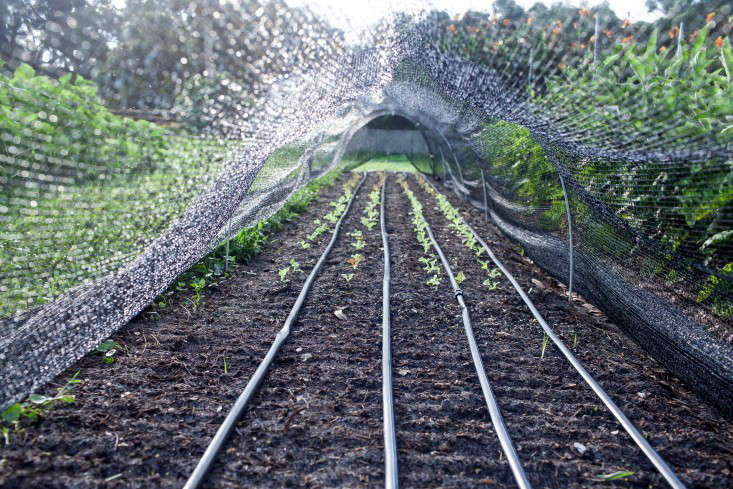
Beneath a hoop tunnel, seedlings get their strength from a drip irrigation system.
What is drip irrigation?
Drip (trickle, micro, or localized) irrigation benefits plants and crops by delivering water straight to their roots on a slow drip, thereby saving water and fertilizer.
Far from being a new trend, though, the concept has been around for centuries since farmers in China started to control the flow of water using unglazed pots placed near trees.
Graphic by Dalilah Arja. A pressure regulator keeps water flowing at a steady rate to the drip system, and the filter removes sediment and debris that can clog an irrigation system.
Why is drip irrigation good for the environment?
It delivers water directly to the root zone of a plant, so less water is lost from evaporation or runoff, which has the added benefit of reducing erosion. This is particularly good for mulched areas because the water can soak the mulch without washing it away.
Photograph by Michelle Slatalla.
An adjustable sprayer attached to a drip irrigation system.
Why is drip irrigation good for plants?
Drip irrigation delivers water at a consistent rate. When plants get all the water they need, their growth is not inhibited by water stress (which occurs when there isn’t enough water to extract from the soil).
Turn a water trough into a raised bed. The homeowner attached an irrigation hose through the trough’s drainage hole.
Photograph by Marla Aufmuth for Gardenista.
With an initial outlay of time and cost for planning and installation, the gardener who invests in a drip irrigation system will have the assurance that the garden is being effectively watered with a minimum expenditure of effort and cost.
What’s in it for the gardener?
Installing drip irrigation in a raised bed edible garden in LA.
Photograph courtesy of Pam Rownak.
The cost to install a drip irrigation system averages from $2.50 to $4.50 per square foot, depending on labor costs in your region.
How much does installing drip irrigation cost?
How do I install a DIY drip irrigation system?
For DIY’ers, the best advice is to start simple and small.
Photograph by India Hobson.
A low-tech irrigation system is in place in England’s West Midlands. For more, see Studio Visit: Glasshouse Flowers with India Hurst of Vervain.
Drip Irrigation Recap
Pros:
Photograph courtesy of StartOrganic.
PayPal’s headquarters in San Jose is home to an organic vegetable garden with a drip-irrigation system so employees can grow their own food.
Cons:
A Stylish Way to Water Your Plants While You’re Away takes the drip irrigation principle indoors.